07.0 - MANAGING PLANNNING & SCHEDULING
07.1 - Module 07-1 - Introduction to Managing Planning & Scheduling
07.2 - Module 07-2 - Develop the Planning & Scheduling Policies & Procedures Manual
07.3 - Module 07-3 - Identify / Capture all Schedule Activities
07.4 - Module 07-4 - Create the Logical Relationships & Sequence Activities
07.5 - Module 07-5 - Assigning Resources to all Activities
07.6 - Module 07-6 - Calculate the Duration of Each Activity
07.7 - Module 07-7 - Calculating Float and the Critical Path
07.8 - MODULE 07-8 - VALIDATE THE CRITICAL PATH AND COMPLETION DATES
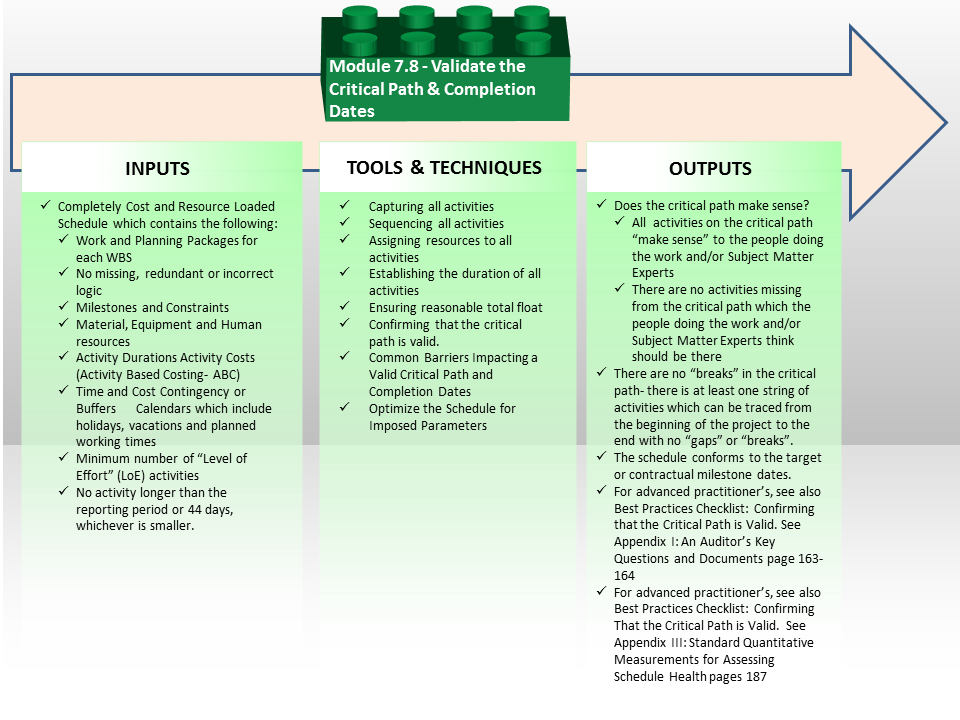
Figure 1 - Validate the Critical Path & Completion Dates Process Map
Source: Guild of Project Controls
07.8.1 INTRODUCTION
Up to this point, the project planner/scheduler has been working closely through schedule development meetings involving key stakeholders, in particular those who are going to actually be executing the work to create a CPM schedule which is “realistic” and “achievable” given the available resources, working conditions and other constraints. The project planner/scheduler has also been working collaboratively with the cost estimators or project controllers to ensure that the costs have been loaded onto the activities and that the schedule has been analysed to ensure that the appropriate trade-offs between time and cost have been made to the satisfaction of the key stakeholders and that appropriate time and cost contingency and/or buffers have been added to the activities.
Having done this, the project control team is now ready to conduct a series of internal” Quality Control Audits” on their project schedule prior to “going live” with it. Those three quality checks are:
- Validate that the critical path is “valid”- that it makes sense and is realistically achievable
- Validate that the schedules “roll up” and “roll down” without losing activities or data
- Validate the schedule using a Monte Carlo simulation to calculate the probability of finishing on any specific date
07.8.2 INPUTS
Completely Cost And Resource Loaded Schedule Which Contains The Following:
- Work And Planning Packages For Each Wbs Element (100% Of Necessary Activities)
- No Missing, Redundant Or Incorrect Logic
- Milestones And Constraints
- Material, Equipment And Human Resources
- Activity Durations Which Are Realistic And Achievable
- Activity Costs (Activity Based Costing- Abc)
- Time And Cost Contingency Or Buffers Appropriate To The Riskiness Of The Project, Work Package And/Or Activity
- Calendars Which Include Holidays, Vacations And Planned Working Times Minimum Number Of “Level Of Effort” (Loe) Activities
- No Activity Longer Than The Reporting Period Or 44 Days, Whichever Is Smaller unless otherwise justified
07.8.3 TOOLS & TECHNIQUES
07.8.3.1 Characteristics of a Reliable Schedule
The GAO Schedule Assessment Guide - Best Practices for project schedules have provided some useful characteristics which explain what consists a good schedule:
- Comprehensive, reflecting
- all activities representing the scope as defined in the project’s WBS
- the labor, materials, and overhead needed to do the work and whether those resources will be available when needed
- how long each activity will take, allowing for discrete progress measurement with specific start and finish dates
- Well-constructed, with
- all activities logically sequenced with predecessor and successor logic
- limited amounts of unusual or complicated logic techniques that are justified in the schedule documentation.
- a critical path that determines which activities drive the project’s earliest completion date
- total float that accurately determines the schedule’s flexibility
- Credible, reflecting
- the order of events necessary to achieve aggregated products or outcomes
- key dates that can be used to present status updates to management
- a level of confidence in meeting a project’s completion date and any major milestones based on data about risks and opportunities for the project.
- necessary schedule contingency and high priority risks based on conducting a robust schedule risk analysis
- Controlled, can be / is
- updated periodically by schedulers trained in scheduling
- statused using actual progress and logic to realistically forecast dates for program activities
- compared against a documented baseline schedule to determine variances from the plan
- accompanied by a corresponding baseline document that explains the overall approach to the project, defines assumptions, and describes unique features of the schedule
- subject to a change / configuration management control process
Reference - Adapted from “GAO Schedule Assessment Guide- Best Practices for Project Schedules” (2012) pages 152-153
07.8.3.2 Tools & Techniques for validating the Critical Path and Completion Dates
The GAO Schedule Assessment Guide - Best Practices for project schedules have provided ten good practices associated with a high-quality and reliable schedule. The Modules below are based around and are supportive of these practices. Their concepts are as follows:
- Capturing all activities. The schedule should reflect all activities as defined as being necessary by the project’s WBS and must include activities both the owner and contractors are to perform.
- Sequencing all activities. The schedule should be planned so that critical project dates can be met. To do this, activities need to be logically sequenced. In particular, activities that must be completed before other activities can begin (predecessor activities), as well as activities that cannot begin until Introduction and other activities are completed (successor activities), should be identified. Date constraints and lags should be minimized and justified. This helps ensure that the interdependence of activities that collectively lead to the completion of events or milestones can be established and used to guide work and measure progress.
- Assigning resources to all activities. The schedule should reflect the resources (labor, materials, overhead) needed to do the work, whether they will be available when needed (if not available the schedule is not feasible and should be adjusted), and any funding or time constraints.
- Establishing the duration of all activities. The schedule should realistically reflect how long each activity will take. When the duration of each activity is determined, the same rationale, historical data, and assumptions used for cost estimating should be used. Durations should be reasonably short and meaningful and allow for discrete progress measurement. Schedules that contain planning and summary planning packages as activities will normally reflect longer durations until broken into work packages or specific activities.
- Ensuring reasonable total float. The schedule should identify reasonable float (or slack)—the amount of time by which any activity can slip before the slippage affects the programmes estimated finish date—so that the schedule’s flexibility can be determined. Large total float on an activity or path indicates that the activity or path can be delayed without jeopardizing the finish date. The length of delay that can be introduced and accommodated without the finish date’s slipping depends on a variety of factors, including the number of date constraints within the schedule and the amount of uncertainty in the duration estimates, but the activity’s total float provides a reasonable estimate of this value. As a general rule, activities along the critical path have the least float.
- Confirming that the critical path is valid. The schedule should identify the program critical path. Establishing a valid critical path is necessary for examining the effects of any activity’s slipping along this path. The program critical path determines the program’s earliest completion date and focuses the team’s energy and management’s attention on the activities that will lead to the project’s success. This includes ensuring that there is at least one contiguous (unbroken) path with the project with zero total float. While it is possible to have more than one critical path, at the point where the schedule is being prepared to be baselined, if there are more than one critical path the reason for it needs to be clearly explained and justified.
- While not specifically designed to be in sequence, these practices do conform to the sequence used by most planners and schedulers most of the time.
- Explained another way, if you are a scheduler and no one has provided you with instructions otherwise, then following this step by step process is a safe and prudent approach.
However, because these processes are designed as building blocks, as you become more proficient and confident in your understanding of applied planning and scheduling, you can move these blocks of processes around to suit the particular needs of your industry, client or perspectives. (i.e. for an owner’s project manager will often recommend doing step 4, establishing durations before step 3, assigning resources to each activity.)
07.8.3.3 Common Barriers Impacting a Valid Critical Path and Completion Dates
The most common barriers to calculating a valid (“reasonable”) Critical Path are:
- Incorrect or unrealistic durations
- The wrong or inappropriate logic (i.e. using Finish to Start when the work will actually be executed using Start to Start relationships with or without leads or lags
- Adding inappropriate (either too much or too little) risk contingency or buffers
- Unrealistic resource availability or productivity
- “Game Playing” by contractors. Many contractors, trying to protect themselves against late delivery penalties, will add as many owner activities as possible at the beginning of the project. (i.e. Site Access, Permits, Shop Drawing Approvals/Acceptance, Sample Approvals/Acceptance etc) Then they will link as many activities as possible to the owner’s activities with small values of positive float, (near critical activities) and when the owner delays any of these activities (which owners are wont to do) then the contractor invokes the “But For” defense- “Mr. Owner, BUT FOR THE FACT you delayed me at the beginning of the project, I would have finished on time.
For more on contractors “gaming” the CPM schedule, also known as “defensive (or offensive) scheduling” see Module 12 - Managing Forensic Analysis.
One of the biggest barriers to a valid critical path is the use of too many constraints. As noted previously the target should be to include as few constrains as is possible (Ideally, less than 3% of activities constrained and certainly no more than 5% without justification.) All real life constraints should be used, artificial constraints should be avoided.
07.8.3.4 Optimise the Schedule for Imposed Parameters
The project may pose limitations on the schedule and need to be revised and the schedule, adjusted to cater and accommodate them. Imposed parameters could consist of:
- There may be insufficient space to use specific plant and machinery
- There may be insufficient room to employ the optimum manpower envisaged for carrying out a specific operation or activity
- The project location may dictate alternative construction methods or may impose limitations on when specific operations can be carried out
- The company or contractor may have resource limitations or insufficient manpower to deliver what the initial schedule dictates
- There may be project financing limitations
- The project will certainly have some critical or “key dates” and certainly an overall completion date and the schedule needs to be adjusted to accommodate each of these
The objective being to ensure that the schedule meets the required dates given the constraints and risk events likely to occur and whether the project can physically be built.
07.8.4 OUTPUTS
- Does The Critical Path Make Sense? - are the things you think should be critical actually critical?
- All Activities On The Critical Path “Make Sense” To The People Doing The Work And/Or Subject Matter Experts
- There Are No Activities Missing From The Critical Path Which The People Doing The Work And/Or Subject Matter Experts Think Should Be There
- There Are No “Breaks” In The Critical Path- There Is At Least One String Of Activities Which Can Be Traced From The Beginning Of The Project To The End With No “Gaps” Or “Breaks”.
- The Schedule Conforms to the target or Contractual Milestone Dates.
Best Practices Checklist: The Critical Path & Completion Dates: (Adapted from GAO “Best Practices in Scheduling”)
- The schedule’s critical path is valid. That is, the critical path or longest path in the presence of late-date constraints
- - does not include LOE activities, summary activities, or other unusually long activities;
- - is a continuous path from the status date to the major completion milestones;
- - does not include constraints so that other activities are unimportant in driving the milestone date;
- - is not driven in any way by lags or leads;
- - is derived in summary schedules by vertical integration of lower-level detailed schedules, not preselected activities from management.
- If backward-pass date constraints are present on activities other than the finish milestone, both the critical path and the longest path have been identified. With a number of constraints, activities with zero or negative total float may outnumber activities that are actually driving the key project completion milestone.
- The critical path, or longest path in the presence of late-date constraints, is used as a tool for managing the program. That is, management
- - has vetted and justified the current critical path as calculated by the software;
- - uses the critical path to focus on activities that will be detrimental to the key project milestones and deliveries if they slip;
- - examines and mitigates risk in activities on the critical path that can potentially delay key program deliveries and milestones;
- - has reviewed and analyzed near-critical paths because these activities are likely to overtake the existing critical path and drive the schedule;
- - recognizes not only activities with the lowest float but also activities that are truly driving the finish date of key milestones;
- - evaluates the critical path before the schedule is baselined and after every status update to ensure that it is valid.
07.8.5 REFERENCES & TEMPLATES
- GAO “Best Practices In Scheduling”
- GAO "Cost Estimating And Assessment Guide Best Practices For Developing And Managing Capital Program Costs"
07.9 - Module 07-9 - Validating Horizontal & Vertical Integration
07.10 - Module 07-10 - Conducting a Schedule Risk Analysis
07.11 - Module 07-11 - Baselining & Communicating the Schedule
GPCCAR M07-8, Revision 1.02