05.0 - MANAGING CONTRACTS
05.1 - Module 05-1 - Introduction to Managing Contracts
05.2 - Module 05-2 - Develop The Managing Contracts Policies & Procedures Manual
05.3 - Module 05-3 - Select Project Delivery Method / Contract Type
05.4 - Module 05-4 - Tendering & Bidding The Project
05.5 - Module 05-5 - Managing the Contract (Owner & Contractor)
05.6 - MODULE 05-6 - CLOSING THE CONTRACT (OWNER & CONTRACTOR)
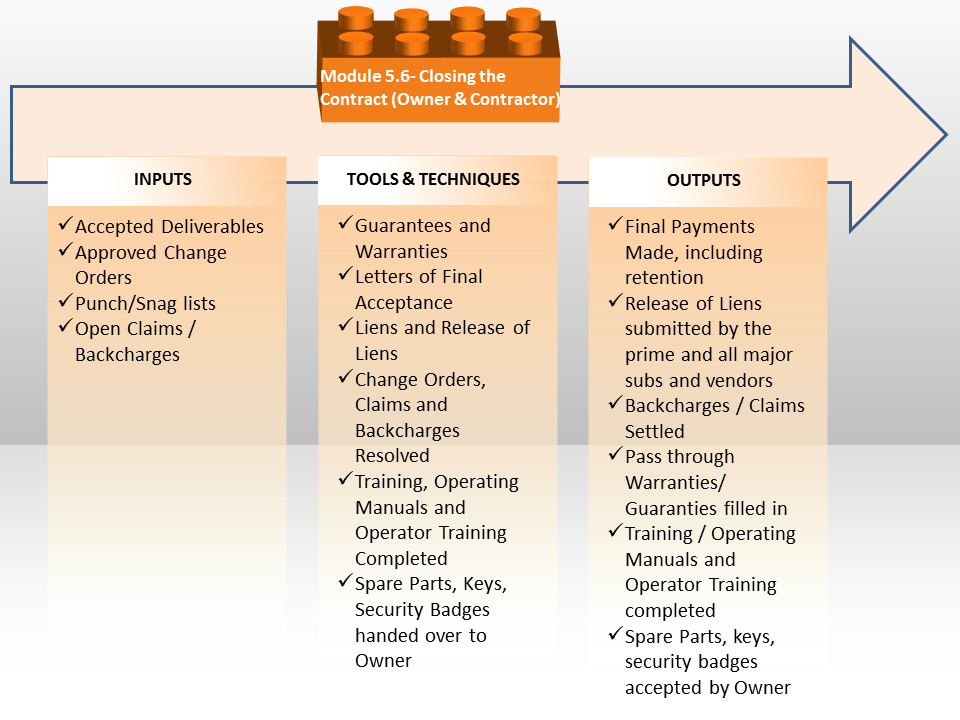
Figure 1 - The Closing the Contract Process Map
Source: Guild of Project Controls
05.6.1 INTRODUCTION
Closing out a contract is primarily an administrative process which ensures that all loose ends have been taken care of, that all the paperwork is done and that charge accounts are closed out. Based on research by the Guild of Project Controls “best tested and proven” practices indicate there are 12 steps to formally closing a contract, not all of which can or should be used on all projects. However, this list provides a hand checklist for use by the project controls team:
- STEP 1: DETERMINING WHO IS RESPONSIBLE FOR CONTRACT CLOSEOUT - In contract closeouts, there are activities which must be completed by all parties, including not only the owner but the contractors and sub-contractors as well. This includes preparing and submitting release of liens from those contractors/vendors listed on the Notice To Proceed document as well as testing and commissioning of systems, pass through warranties and guaranties for equipment, licenses for any software, operator training for the software or equipment, spare parts if required and the handover of keys and any “as built” or “red line” drawing. These activities take time, consume resources and project controllers need to ensure that activities and sufficient budget has been allocated for this purpose.
- STEP 2: BUILDING A CLOSEOUT FILE - This file should contain all releases of liens, checklists, copies of warranties, guaranties and licenses as well as recording what was turned over and who it was turned over to.
- STEP 3: DETERMINING/VALIDATING PHYSICAL COMPLETION AND QUICK CLOSEOUT PROCEDURES - While at this point, substantial completion should have been reached, making certain that all punch or snag list items have been completed can also be a challenging process. One of the risks in granting beneficial or partial use or occupancy is damage caused by the new owners/operators of the facility should not be the responsibility of the installing contractor or vendors. So some way to ensure that work is punch listed, punch lists have been cleared and work packages accepted BEFORE beneficial use or occupancy is authorized is important.
- STEP 4: PAYMENT HISTORIES AND FUNDING RESOLUTION - Has everyone been paid in full including release of retention? If not, why not? Have all outstanding claims been resolved? If not why not?
- STEP 5: APPLICABLE CLAUSES AND PROVISIONS - Have all the “shall clauses” in the contract been met or fulfilled? If not, why not? And if there are any non-conformance reports, have they been remedied or has there been an adjustment to the price to compensate for reduced or diminished functionality?
- STEP 6: DETERMINING SECURITY CLASSIFICATION - In many projects today, security clearance is required for some or all of the workers. Have security clearances been closed out/revoked and have all badges been turned in?
- STEP 7: LETTER TO THE CONTRACTOR - A letter to the Contractor (and in some cases to the sub-contractors and vendors) stating that their work has been accepted and the project is considered complete needs to be issued
- STEP 8: LETTER TO THE FINANCE - As nearly all projects create or produce assets, these assets need to be turned over to accounting/finance to be entered on the books for the purposes of depreciation and operational cost accounting.
- STEP 9: REQUEST FOR AUDIT - In the event it is required by law or if there is any question about the possible misallocation of funds, this would be the time for the owner’s project manager to request an audit. This is especially important if the contract was cost plus and used “open book” cost accounting methods.
- STEP 10: NEGOTIATION AND INVOICE PAYMENT - In the event that discrepancies or problems were identified in step 4, by this point, they need to have been resolved. This is often a time consuming process and may last for a year or more after the project has been completed.
- STEP 11: FINAL CLOSEOUT DOCUMENTS - All charge accounts should be closed and any excess funds released for use by other departments or projects. This is where “as built” or “red line line” drawings should be
- STEP 12: MANAGEMENT AND LEGAL REVIEW - A report is prepared and issued for the relevant levels of senior and/or functional managers containing the “lessons learned” and recommendations for future projects of this type.
- STEP 13: COMPLETION OF CLOSEOUT ACTIONS - For Project Control or Project Management Office (PMO) the historical databases need to be updated
As the stated purposes of this Body of Knowledge is not only as the basis to prepare for the various GPC Certifications, but to also provide a compendium of references for the practitioner, below are several sources of complete sets of project management documents. These are not theoretical documents but are used by real owner organizations for use on real projects, which mean at some point in time, they have been challenged and tested in a court of law:
- State of Tasmania, Australia- http://www.egovernment.tas.gov.au/project_management/supporting_resourc…
- Washington State (USA) Department of Transportation http://www.wsdot.wa.gov/Projects/ProjectMgmt/OnlineGuide/ToolsForms.htm
- Scottish Government - http://www.gov.scot/Topics/Government/ProgrammeProjectDelivery/Template…
- UK Government Dept of Business Skills (2010) https://www.gov.uk/government/uploads/system/uploads/attachment_data/fi…
For Contractor Organizations here are a partial listing. Understand that to obtain documents from these organizations you most likely need to be a member but you can be assured that the documents provided by these organizations have also been tested and validated.
USA
- Associated General Contractors of America (AGC) https://www.agc.org/
- Associated Builders and Contractors (ABC) https://www.abc.org/
- Engineering and Construction Contracting Association http://www.ecc-conference.org/
- Each Specialty Trade also have organizations with contract and other documents associated with those trades.
Australia
- Australian Constructors Association (ACA) http://www.constructors.com.au
- Independent Contractors of Australia (ICA) http://www.independentcontractors.net.au/
- Civil Contractors Federation (CCF) http://www.civilcontractors.com/
UK
- Royal Institute of Chartered Surveyors (RICS) https://www.rics.org/uk/
05.6.2 INPUTS
- Accepted Deliverables
- Approved Change Orders
- Punch/Snag Lists
- Open Claims / Backcharges
05.6.3 TOOLS & TECHNIQUES
05.6.3.1 Guarantees and Warranties
There are generally two types of guaranties in contracting:
(1) Construction Guarantees which guaranty that the workmanship of the contractor is of sufficient quality to last for a specific period of time, which is usually stated in the contract documents. (usually 1 year)
(2) Product Warranties which are issued by the product or equipment manufacturer. (i.e. pumps, air conditioners, computers etc) These are known as “pass through warranties” and are important to project controllers as we need to be sure to put in an activity in the schedule to ensure that these documents get properly handed over to the end user. This same concept also applies to software licenses for any programs installed by the contractor. If the contractor fails to hand over these warranties or licenses it can severely impact the ability of the end user to get any faulty equipment repaired and the contractor will have to replace it at his/her own costs.
05.6.3.2 Letters of Final Acceptance
This is a legal document which formally establishes the legal date of project completion. For planners/schedulers this is critical as any penalties or bonuses will be calculated from this date.
Below is a generic sample Construction Completion Certificate. There are many templates, which can be found on the internet which apply to any specific type of project. For those studying for the GPC exams, any questions on this topic will be based on the template below, understanding that your organization may use a different template to meet local laws or customs.
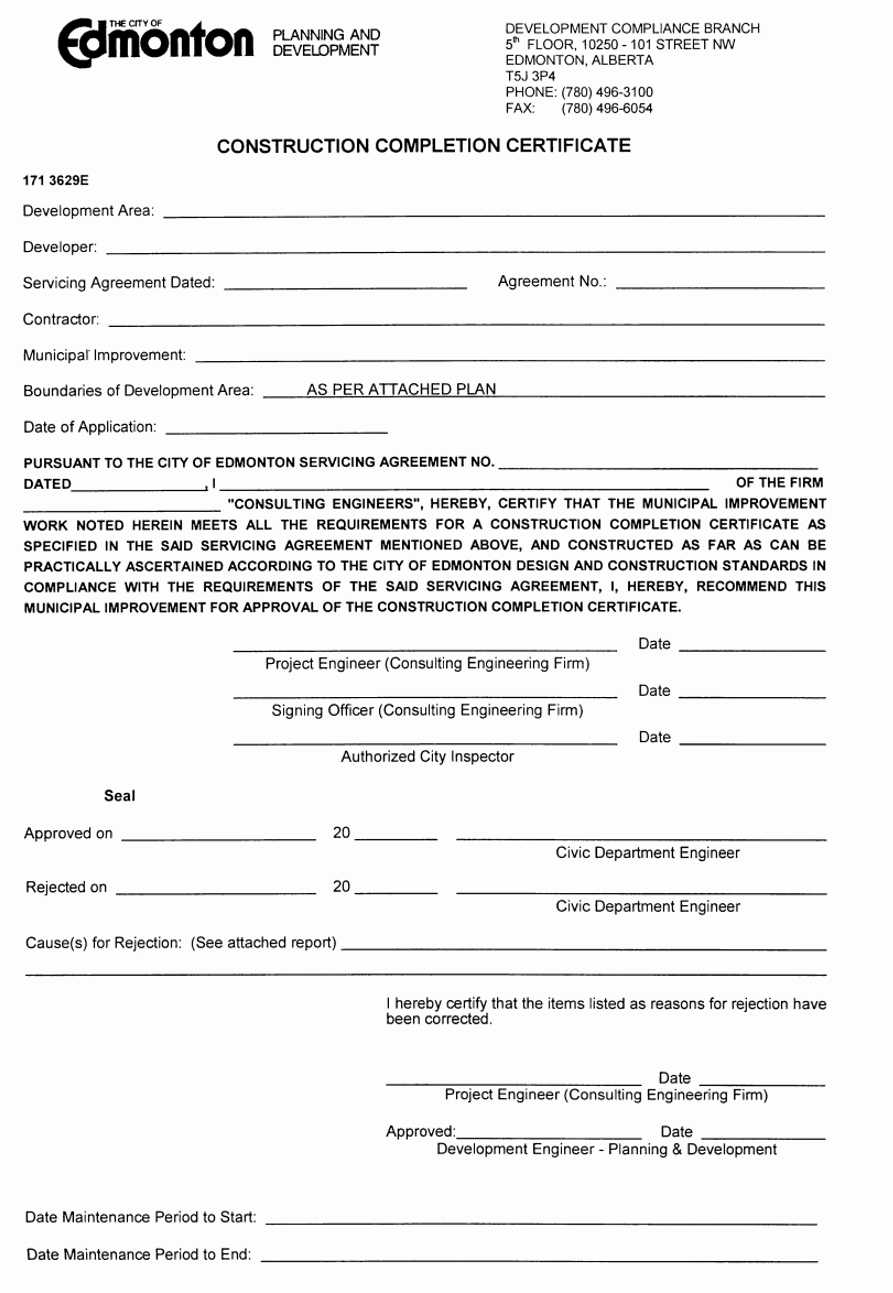
Figure 2 - Sample Construction Completion Agreement
Source: City of Edmonton Canada (n.d.)
05.6.3.3 Liens and Release of Liens
Claim on the improved property by the contractor, subcontractors, laborers, and material suppliers for the monies owed to them. In general, a mechanic's lien takes precedence over any mortgage on that property because, it is assumed, the value of that property has increased to the extent of the lien. Also called materialman's lien.
Given that in many parts of the world, owners are paying their prime contractors but in turn, the primes are not paying the subcontractors, many global organizations with property in countries which do have lien laws (nearly all countries which are based on English law) are requiring the prime contractors to obtain release of liens from their subcontractors, suppliers and vendors.
This is something of significant importance for project controllers to know and understand because if the subcontractors and vendors are being starved for working capital, then it impacts the production rates on the project.
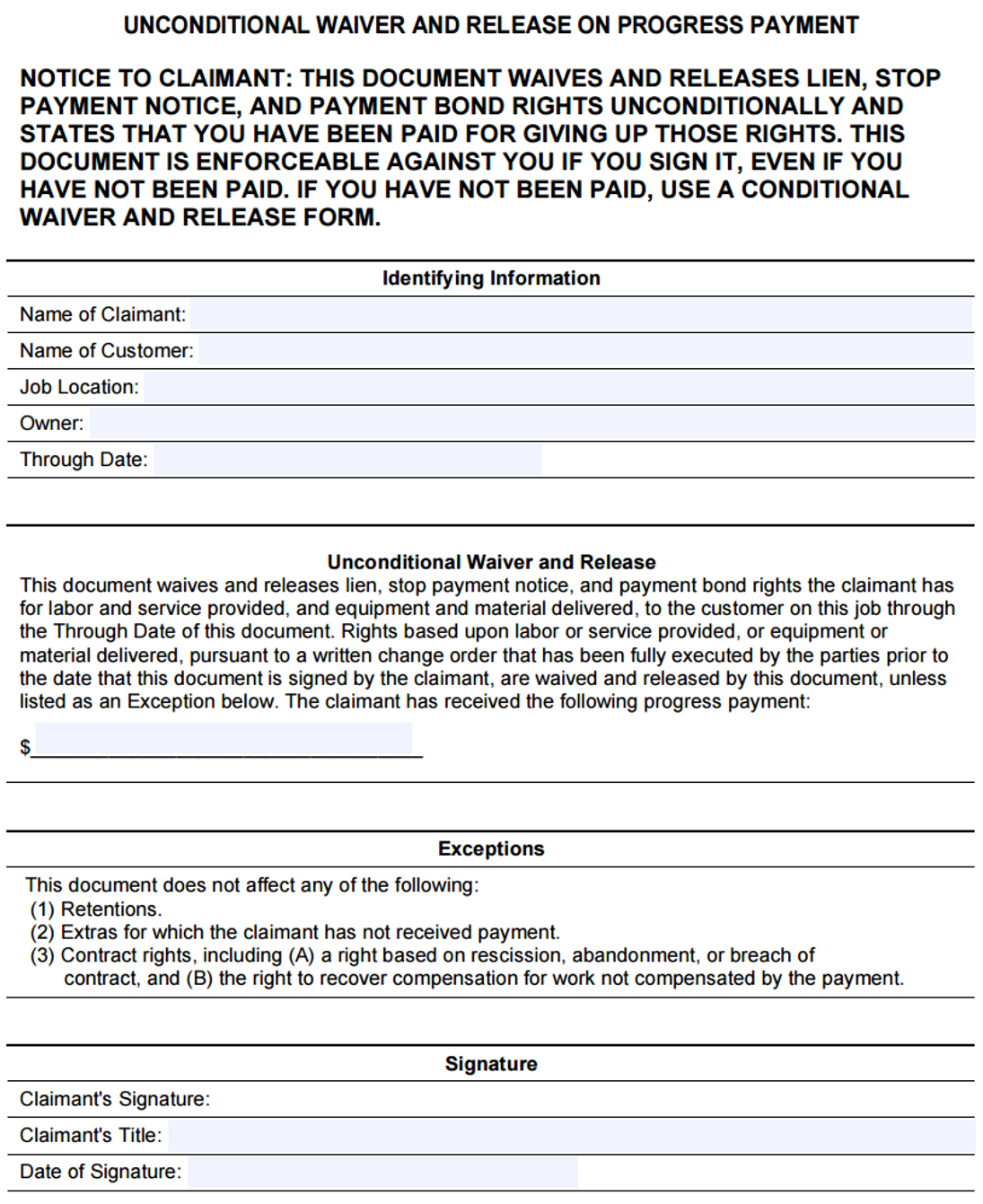
Figure 3 - Sample Release of Lien Form
Source: California Contractors State Licensing Board (2016)
05.6.3.5 Training, Operating Manuals and Operator Training Completed
One of the ways for a contractor to ruin their reputation after what was a more or less “successful” project is to mismanage the handover to the end user of the product the contractor just created. One of the common complaints is the poor job many contractors do during the testing and commissioning as part of the handover to the end user, who is not always the project sponsor.
If the end user is not happy with the product, then it reflects badly on the contractor which means activities, time and money need to be allocated to ensure the handover is done smoothly and completely
For more on this topic, see Module 3 - Managing Scope
05.6.3.6 Spare Parts, Keys, Security Badges handed over to Owner
The last step is to ensure that all the administrative tasks are completed by the contractor. One of the time consuming items often ignored is making certain that spare parts, keys to all the rooms and pieces of equipment are properly tagged and handed over. This is especially true of master keys, which if not managed appropriately, can cause the owner to have to change all the locks on a project.
Another big problem is making certain that security clearances, badges and ID’s are turned back to the owner. Especially when working on airports or nuclear facilities, failure of the contractor to properly close out and return security materials can result in fines or even imprisonment.
For more on this topic, see Module 3 - Managing Scope
05.6.4 OUTPUTS
- Final Payments Made, Including Retention
- Release Of Liens Submitted By The Prime And All Major Subs And Vendors
- Backcharges / Claims Settled
- Pass Through Warranties/Guaranties Filled In
- Training / Operating Manuals And Operator Training Completed
- Spare Parts, Keys, Security Badges Handed Over To Owner
05.6.5 REFERENCES & TEMPLATES
- State Of Tasmania, Australia- Http://Www.Egovernment.Tas.Gov.Au/Project_Management/Supporting_Resources/Templates
- Washington State (USA) Department Of Transportation Http://Www.Wsdot.Wa.Gov/Projects/Projectmgmt/Onlineguide/Toolsforms.Htm
- Scottish Government - Http://Www.Gov.Scot/Topics/Government/Programmeprojectdelivery/Template/Ppmtemplate
- UK Government Dept Of Business Skills (2010) https://assets.publishing.service.gov.uk/government/uploads/system/uplo…
- International Federation Of Consulting Engineers (FIDIC) Http://Fidic.Org/Node/7089
- American Institute Of Architects (Aia) Contract Documents https://www.aiacontracts.org
- Engineers Joint Contract Documents Committee (EJCDC) Https://Www.Ejcdc.Org/
- Consensusdocs Https://Www.Consensusdocs.Org/
- Construction Specifications Institute Manual Of Practice- Http://Www.Amazon.Com/The-Project-Resource-Manual-Practice/Dp/0071370048
GPCCAR M05-6, Revision 1.01