12.0 - MANAGING FORENSIC ANALYSIS
12.1 - Module 12-1 - Introduction to Managing Project Forensic Analysis
12.2 - Module 12-2 - Creating The Forensic Analysis Process & Procedures Manual
12.3 - Module 12-3 - Conduct the Preliminary Analysis
12.4 - MODULE 12-4 - CONDUCT THE SCHEDULE ANALYSYS
12.4.1 INTRODUCTION
In the previous module, we determined that we do in fact, have a substantiated or validated claim situation and in this follow on process module we need to determine what is the best method to show or communicate the impacts to the appropriate and relevant decision makers, be they internal to the project organization or external, to mediators, arbitrators, judges or juries.
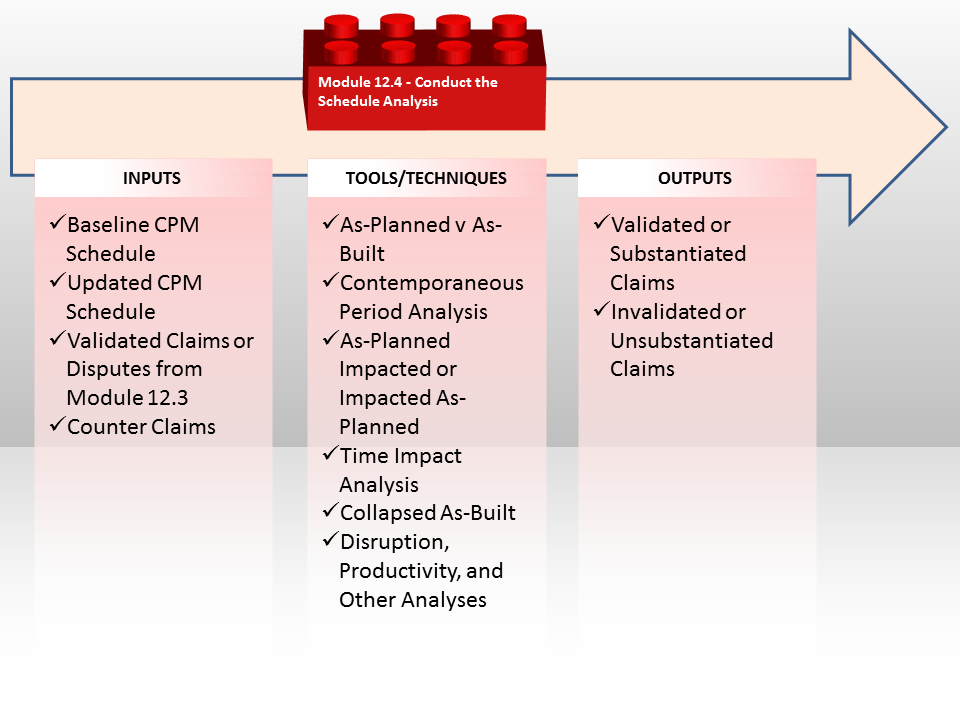
Figure 1 - Process Flow Chart for Conduct the Schedule Analysis
Source: Guild of Project Controls
For the sake of clarity, in some parts of the world, the CPM “schedule” is known as the CPM “program” or “programme”and thus the terms are synonymous and can be used interchangeably.
Claims are fundamentally about change, the nature and circumstance of which determine the basis of entitlement to equitable adjustment and quantum. To prove entitlement to additional compensation the presentation of facts offered to any finder of fact must clearly address the factual basis of entitlement within the contract documents and/or law. Proof must include a demonstrable linkage between cause, effect and quantum.
The major issues of quantum revolve around cost. The bid estimate, monthly job cost records, certified payroll, purchase orders, subcontract agreements, approved change orders files, pending change orders, monthly profit projection all catalog job cost. It is in the detail of these records that the impact of change will be manifested. The failure or success of the various elements of a claim is often determined by the ability to isolate and separate the associated cost with the causal element.
Claims vary from very discrete elements of time and cost to total time and total cost. Total time and cost claims combine all delays or costs on the project into one claim and are less likely to succeed because it is unusual to find that the responsibility for consequential additional expenditure can be attributed solely to one party.
As noted previously, because the nature of claims focuses so much on the nuanced details, we need to develop a more detailed process map.
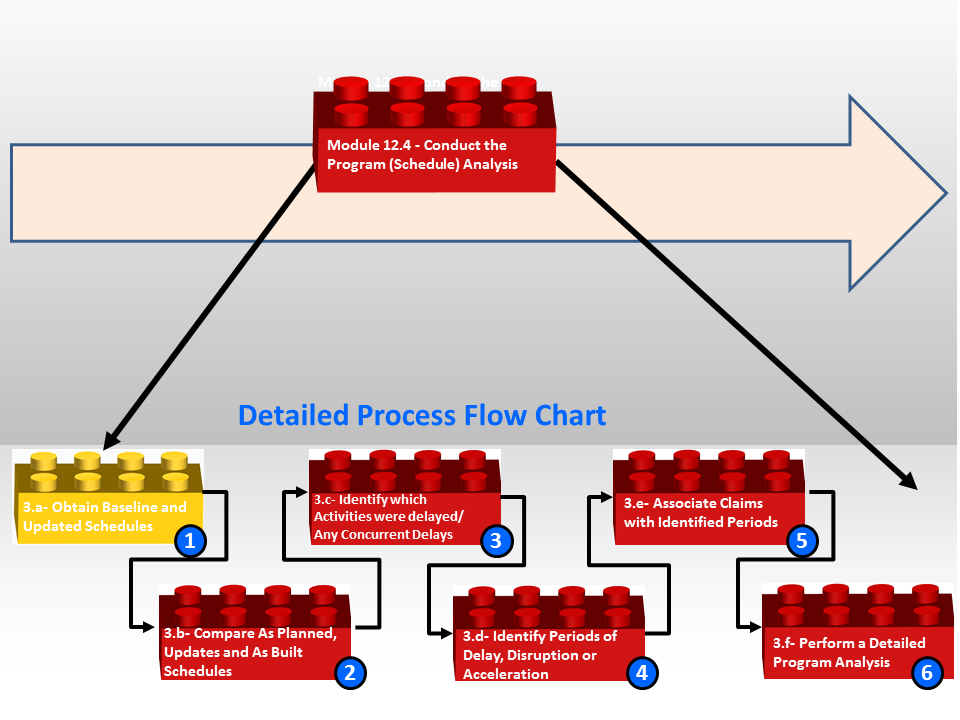
Figure 2 - Detailed Process Flow Chart for Conduct the Program (Schedule) Analysis
Source: Adapted from Livengood, John (2014) “Construction Claims A to Z" CDR 1484 AACE Symposium Bangkok, Thailand
To help us better understand the step by step process, we have to “drill down” one level deeper in our process map.
(1) We INITIATE the schedule (called programme in many countries) analysis by obtaining the original baseline schedule and all the updates per period between the start of the project and the current date.
(2) Using the appropriate tools/techniques identified below, we compare the original “as planned” (Performance Measurement Baseline or PMB) to each update and/or against the “as built” (final) schedule update at the end of the project.
(3) We identify which activities were delayed and if there were any CONCURRENT delays. (More than one string of activities being delayed during the same time frame)
(4) Identify periods where delay, disruption or acceleration occurred.
(5) Then we match up each claim with the relevant time frame and lastly
(6) Conduct an overall assessment of the entire schedule or programme.
To accomplish these steps we need to understand in more detail what each of these steps requires before we get into the specific tools & techniques at our disposal.
The items below provides a more complete explanation or elaboration supporting how to implement or follow this detailed process map.
(1) SELECTION OF EXPERTS
There is a fundamental delineation between “technical” or “engineering” experts and “scheduling and cost” experts. When dealing with technical, engineering issues of design and code, it is wise to carefully choose professionals recognized as experts in the relevant field to investigate and render opinion in their given area of expertise. It is unwise to assume that these same people are capable of performing the overall schedule and cost analysis necessary to the preparation of the delay and disruption claim. It is better to hire attorneys and “claims” consultants experienced and knowledgeable in the preparation and presentation of construction claims. Both are aware of the cost of dispute resolution and depending on the size and nature of the dispute, will generally work within an agreed budget based on an agreed scope of work.
Claim preparation cost can be often be minimized by utilizing the client’s personnel to do such time consuming chores as research, data input and copying leaving the expert’s time to investigation and analysis.
(2) THE AS-PLANNED PROGRAMME OR SCHEDULE
As noted earlier, the form of contract may require the production and submission of a planned programme, however irrespective of whether this is the case or not the initial planned programme is often referred to as the ‘Contract’ Programme or Schedule, but might also be referred to as the As-Planned Schedule or Baseline Schedule.
Again as noted previously and irrespective of the contract requirements it is important that the submission, approval / acceptance, monitoring and revisions of the planned programme are formally recorded during the course of the works particularly if the programme is being issued in an electronic format. Such practices as the informal issue of revised planned programmes during site meetings should be avoided. The initial planned programme is of some obvious importance as it represents the planned intent at the commencement of the works and the baseline from which to measure any divergence in terms of sequencing and timing. Contractor’s planned programmes may however, tend to lack certainty for a number of reasons including;
- At the outset of the project elements of design for which the contractor is responsible may not have been fully developed;
- The Employer’s specification and design of the works may in areas not be developed and will be covered by provisional sums;
- With works tending to become much more sophisticated and technical, input from specialist subcontractors and suppliers will be of importance, with this required necessary input not being fully developed at the early stages of the project;
- Allowances may need to be made for unknown factors such as likely environmental conditions and the availability of labour;
- As the works progress better ways might be found of sequencing the works;
- Standard labour outputs will be based on historical and published data as well as on general experience; however elements of the project are likely to be unique with expected outputs difficult to accurately ascertain.
As well as the above it can also be difficult to plan too far ahead with any accuracy and to a certain extent there may be no need to do so. More detailed planning tends to be undertaken over short periods of time and between identified milestones.
Overall planned programmes tend to outline strategy for the project implementation whereas the more short term programmes may indicate a more tactical approach for undertaking the works.
Taking a construction project having a duration of two years; at the commencement of the works the exact timing of the various elements of the Owner’s Representative finishes may not be of great importance. At this time of commencement, the site team might be focused on achieving the first perceived milestone which may relate to clearing and preparing the site ready for the start of piling operations.
Once this first milestone has been achieved forward detailed planning will relate to the construction of the foundations in anticipation of the following milestone of the commencement of the steel frame.
This is not to imply that the overall planned programme will be disregarded and the contractor will need to be mindful of the overall strategy and timescale laid down by the overall planned programme, but simply that the level of detail may be limited in the early programmes or schedules. This does not lessen the need to evaluate any delays and determine the causes of those delays. But the As-Planned or Baseline Schedule should still contain full scope of work, detail enough to identify the sequencing and phasing, as well as reasonable and appropriate duration estimates and resource needs.
The timing of the various milestones will need to comply with the main planned programme, however due to the previously mentioned uncertainty as well as any incidents of delay/impact the planned programme may not reflect the timing and the actual sequence of works being carried out on site. This may necessitate a need for the planned programme to be revised and re-issued.
Any planned programme will therefore likely contain a certain element of uncertainty.
(3) THE AS-PLANNED PROGRAMME OR SCHEDULE AND AS-BUILT RECORDS
As emphasised earlier, the maintaining of records reflecting what actually occurred are of great importance.
Some of the available software will allow actual start and finish dates to be input along with recorded progress thus creating an as-built programme as the planned programme is updated with progress. This will produce a good comparison with the as-planned activities but may lack detail and will not necessarily reflect such aspects as intermittent working.
As an example, taking a planned activity entitled ‘Install Cladding’, a direct as-built comparison with the planned may for instance clearly indicate a late commencement and prolongation of the works but will not necessarily indicate periods when no works were undertaken, the actual sequence of installation and allied works such as the fixing of flashings, access scaffolding, remedial works etc.
A direct comparison with the planned activity can prove very useful; however with discrete issues of delay/impact further detail is often required. This further detail can be drawn from a variety of sources relating to such issues as the timing of variation works, plant breakdowns, adverse weather, necessary remedial works, the timing of drawing issues and technical queries.
Notwithstanding this potential requirement for additional detail and as commented in the following section the creation of an As-planned vs. as-built programme is a useful starting point in any delay/impact analysis.
Even where good records have been kept it is likely that the definition of the actual timings may lack an element of certainty and may be a little subjective. As a general observation, records will often define when particular works or trades commenced but recording and ascertaining when they were complete sometimes proves to be a little bit more difficult.
This will be dependent on the nature of the project and of the work activity. As an example the construction of the foundations are likely to be well recorded as it is relatively simple to define what works are in progress at any particular time and there will be good records to define completions in as much as there should be concrete delivery, pour and testing records.
Records relating to other aspects of the works are more difficult to maintain and as such the definition of the exact completion of such works as first fix services installations and various of the Owner’s Representative finishes operations may prove more difficult. In some cases the Owner’s Representative finishes works will continue up to around final completion with differentiation between the timing of the completion of installations, any necessary remedial works and snagging also proving difficult.
Although it may be possible to ascertain the actual start and completion of certain activities with reasonable certainty a further difficulty relates to definition of when a specific activity can be considered as being ‘substantially’ complete with the remaining work having little consequence. A particular element of the works may be defined as actually taking 20 weeks to complete, however the contemporaneous progress reports indicate that after 12 weeks they were considered as being 95% complete.
In this case it may be reasonable to conclude that these works were substantially complete 12 weeks after commencement. However, definition of what this 5% relates to may be difficult and raises the question of whether the final 5% of the work, carried out in the final 8 weeks was of any importance. These decisions should be handled objectively and scientifically, using established protocols, performed uniformly, and be considered an output of expert opinion.
Definition of the overall duration and any consideration of substantial completion will be of particular relevance if the as-built programme is required to be logic linked.
(4) THE USE OF CRITICAL PATH ANALYSIS
Critical Path analysis is generally seen as the most appropriate and accurate way to analyze delays in a project, but it requires the Critical Path Method programmes and schedules in order to do so. It is vital that the CPM schedule is a reasonable model of the project plan at all times during the analysis, or the results from that analysis may have a high rate of error.
There are a number of ways to analysis using CPM scheduling, and each of the methodologies has specific conditions for use. These conditions relate to the implementation, the documents available, and the specific components under evaluation.
Summary:
- When used prospectively for project management purposes the applied logic sometimes requires revision, particularly following the input of progress to ensure that the forward sequence of the remaining works is reasonable. Similarly during its use in delay/impact analysis the logic may also need such revisions to ensure that the network remains reasonable and in accord with the facts and contemporaneous documents.
- These revisions may be reasonable adjustments however such ‘tinkering’ with the logic is often criticised as being a manipulation of the results, so limiting revisions when at all possible is desirable.
- Critical path analysis can be technically challenging and requires specialist user knowledge to use and to interpret the results, however, as a scientific analysis, it is important that the analyst documents assumptions, decisions, and especially any revisions or adjustments required.
- When used for detailed delay/impact analysis it can become extremely complex and the more that the analysis is done scientifically, the lower the rate of error.
- Scientific analysis should be able to be replicated by another expert using the same protocols and assumptions.
(5) THE USE OF WINDOW PERIODS IN ANALYSIS
Although the term “Windows” is occasionally used as a term to describe a specific analysis methodology, it is important to understand that Window analysis is not a stand-alone form or methodology of analysis, but is instead an enhanced technique of implementing a variety of the methods described below. It is a helpful way of enabling delay/impacting events to be analysed over discrete short periods of time or ‘windows’, regardless of the common use of the term for a variety of methods. Therefore, a “windows” approach could be applied to the As-Planned vs. As-Built, the Contemporaneous Period Analysis, and the Collapsed As-Built – meaning that each method could benefit from dividing the analysis periods into slices that would enhance the analyst’s ability to identify delays and determine causation. This visual approach to analysis generally requires the use of periodic schedule updates, and can be applied to several of the forensic analysis methodologies; see the appropriate sections for details.)
The choice and definition of the periods of time used to form the windows will be dependent on the circumstances, however it is common practice to time the start and finish of the windows to coincide with the monthly progress update and progress report. Occasionally the start and finish points for windows are identified to correspond with specific delay events which are of interest to the analyst. Although this is potentially valuable, it is inadvisable to have analysis windows which are wider than the period encompassed by the progress updates. The monthly update should be the maximum width of a window, or the monthly update date should be one boundary of the chosen window.
By analysing the status of the works at the start and end of each window any delay/impact or gain in the period can be quantified. As an example (using the Contemporaneous Period Analysis as a methodological framework), assume that a programme calculated as of the end of August predicts a 3 week delay/impact to overall completion, and that the next updated programme (accounting for the progress reflected in the contractor’s progress report records and revised means and methods) predicts a 4 week delay/impact. In this example, the one-month window between August and September shows a delay/impact of 1 week.
This delay/impact of 4 weeks will form the start of the next window and will enable any further delay/impact or gain to be quantified within the following selected period or window. The delay/impact at the end of the final window will represent the overall actual delay/impact to completion. The contemporaneous documents must support the detailed information necessary to choose the window periods and research conditions within those periods.
Again, the foregoing example used as its framework the Contemporaneous Period Analysis; however, most of the analysis methodologies discussed below can benefit from using a windows approach. For instance, the Collapsed As-Built method can benefit greatly from breaking the analysis into windows, in order to analyze criticality at various points in the project. However, regardless of the analysis methodology in use, the windows will only indicate the extent of any delay/impact in the selected periods and will not indicate the cause(s) of such delay/impact, even if the causal activities for delay can be identified. How the cause of delay/impact is analysed will be dependent on the practitioner and the circumstances, but generally the rate of error in the analysis methodology is reduced through appropriate and thorough research into the contemporaneous documentation to determine all driving issues for the causal activities of delay.
Identification of the critical works during the period and a simple comparison of the planned intent at the start of the window with what actually occurred may prove appropriate. Although this is ideally the case in some circumstances it may be considered useful that some form of insertion of impacts during analysis be performed to demonstrate that the delay/impacting event caused the delay/impact recorded at the end of the window.
The advantage of reviewing the works within these shorter window periods is that only a limited number of activities will need to be considered.
The windows technique may be used without insertion of delay events, or with the insertion as performed in retrospective time impact analysis. Time impact analysis starts with the cause and then forensically reviews the affect whereas a windows technique starts with the identification of the affect and involves research to ascertain the cause.
The windows do not necessarily need to be based on the monthly progress reporting and it is up to the practitioner to decide what is the most appropriate. It may be considered beneficial to base them on key events, for instance if the erection of the structural steelwork is identified as commencing 4 weeks later than planned the first window could form the period from initial project commencement up to this point. The following window could then, for example cover the period from this commencement of the steelwork through to say the achievement of a weather tight environment and the start of the internal fitting out operations.
A windows analysis will be dependent on such factors the efficacy of the planned programme as well as the progress reporting undertaken during the course of works, however as stated above the breaking down of the project into discrete and manageable periods of time is advantageous.
Summary:
- Requires a fully logic linked as-built programme updated with progress;
- Requires as-built records to be able to review the causes of delay/impact occurring within the window;
- Breaks the works down into manageable periods, enabling analysis to focus on limited activities;
- Based on contemporaneous updates and what occurred;
- If programme has not been updated with progress contemporaneously it may prove difficult to re-create retrospectively and may contain elements of subjectivity.
(6) ACCELERATION & MITIGATION
There are also occasions on projects where the contractor is instructed to accelerate its performance of the works. The reasons for the acceleration are often complicated and the need for accurate record keeping in these circumstances is vital to any proper determination of the effect of such an instruction.
Acceleration usually includes an increase in the labour force needed to complete the remaining works by the completion date in the contract. It can however, include an increase in the site overhead necessary to manage the increase in labour. Whenever acceleration was asserted, very quick response was needed to identify the additional labour and staff. This means that the existing levels of labour and staff needed to be quickly established too, so these are important records for the forensic analyst. If good labour allocation records were kept together with updated organisation charts and roles and responsibilities, then identifying the additional personnel is not too difficult. If those records were not kept well then it is much more difficult.
The records should be investigated irrespective of whether the contractor had actually been instructed to acceleration or the contractor alleged that it had to accelerate because it had been delayed/impacted by the owner without recognition or compensation (constructive acceleration).
(7) CHOOSING A DELAY / IMPACT ANALYSIS METHODOLOGY
The critical path network schedule is a powerful tool for scheduling future work activity. It is the major tool utilized to identify and analyze the as-built critical paths and delays to those paths. Time extension entitlement studies are a major focus of forensic CPM critical path analysis. However, time entitlement is not the only agenda of the forensic schedule analysis.
Occurrences of disruption of work and loss of productivity may or may not involve critical path delay/impact. The source, timing and interrelationship of disrupted or impacted work activity with the other activities of the work is extremely relevant to cost and should be analyzed within the context of the as-built schedule.
The choice of delay/impact analysis methodology is dependent on many factors. There is not a single methodology that can be employed to suit all of the very many and often unique circumstances of delay and impact.
All of the recognised techniques are subject to various strengths and weaknesses. When deciding on the technique to be employed when preparing a claim or a response to a claim for delay/impact it is important that all of these strengths and weaknesses are fully understood.
The following identifies the advantages and disadvantages associated with the various techniques. However it is not the purpose of this guide to provide any form of recommendation. The employment of an appropriate technique will be dependent on the circumstances.
- Prior to embarking on the preparation of a delay/impact analysis, which may well prove to be time consuming and costly, some consideration needs to be given as to the benefits and the ultimate objectives.
- With a simple variation a notice providing detail of the circumstances and quantifying the likely (or actual) impact may prove sufficient to obtain the required award of extension of time.
- Similarly if the opposing party’s opinions with respect to entitlement to extension of time are not vastly divergent a simple form of analysis may be appropriate in order to open dialogue and to achieve a mutually agreeable financial settlement.
- No matter what technique is employed any delay/impact analysis should be readily transparent, easy to understand and in accord with the factual evidence.
- Prior to the widespread availability of the personal computer, planning was undertaken manually employing hand drafted programmes and the like. Any form of complex and technical delay/impact analysis was therefore largely limited.
- The introduction of the personal computer and commercially available critical path based project management software in the mid 1980’s meant that a more technical approach to planning and delay/impact analysis techniques was readily available.
- These readily available computer based programmes brought with them a ‘scientific’ approach to delay/impact analysis as well as a sense of certainty. However, this sense of certainty was often misconceived. By the 1990’s it was probably not unreasonable to suggest that any major formal delay/impact claim not based on some form of computer based analysis and accompanied by a plethora of coloured charts and programmes was viewed as lacking credibility.
- It is not possible to define exactly the views of the various courts with respect to the above computer based methodologies or what they require in respect of the analysis of delay/impact, however in general, the use of CPM analysis has become the preferred approach, and the contemporaneous documents along with the as-built conditions of the project provide the higher confidence levels from analysis. Analysis of issues on the project without correlation to the schedule or programme critical path delays is unlikely to prevail in a formal dispute.
- Analyses that are found to be theoretical are highly likely to be rejected in favour of those analyses that reflect what actually occurred.
- Formal dispute venues reflect a requirement for an objective analysis based on a reliance on the facts and analyses that are readily understandable and transparent.
- Any delay/impact analysis will be dependent on the validity of the available data such as the planned programme(s), progress reports, as-built records and the like.
In the next section the main recognised delay/impact analysis methodologies are discussed in detail, however the general data necessary to carry out these delay/impact analysis techniques is given in the table below, based on a table from the Society of Construction Law Delay and Disruption Protocol, October 2002:
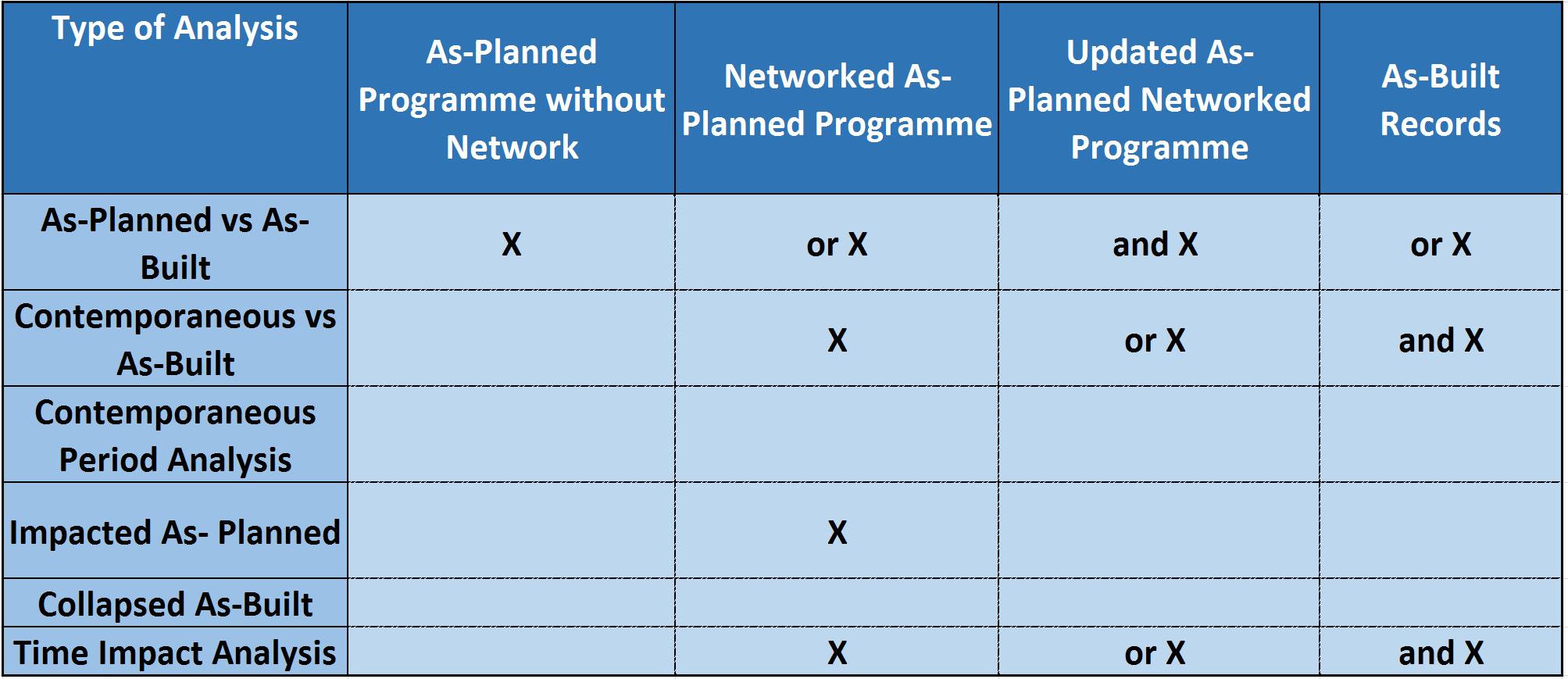
Figure 3 - Information Required for Delay/Impact Analysis
Source: [ pending relevant citation ]
A portion of the above table has been reproduced in part from the Society of Construction Law Delay and Disruption Protocol although that protocol was not designed specifically as a forensic analysis document but rather a project planning and scheduling document. The reference to ‘Up-dated as-planned network programme’ refers to such a planned programme updated with progress.
In respect of the requirements for an as-planned vs. as-built programme the above suggests that as well as the planned programme there is a requirement for an updated programme or as-built records. We consider that as-built records are essential as the updated programme may not provide sufficient as-built data.
The above SCL Protocol chart does not include reference to the ‘windows’ approach, however the data required for the CPA technique generally called a “windows” methodology would be the same as that outlined above for the use of a ‘time impact analysis’ as added in the table.
The Association for the Advancement of Cost Engineering (AACE) International published a forensic document called Recommended Practice No. 29R-03 “Forensic Schedule Analysis” which addresses source requirements for all methodologies (numbering system of Methods is found in the Schedule Analysis Methodologies section below):

Figure 4 - The Source Data Validation Needed for Various Methods” (AACEFSA RP)
Source: [ pending relevant citation ]
From the above all of the methodologies require the utilisation of at least one of the following:
- As-Planned programme;
- As-Built programme / records;
- The use of critical path analysis.
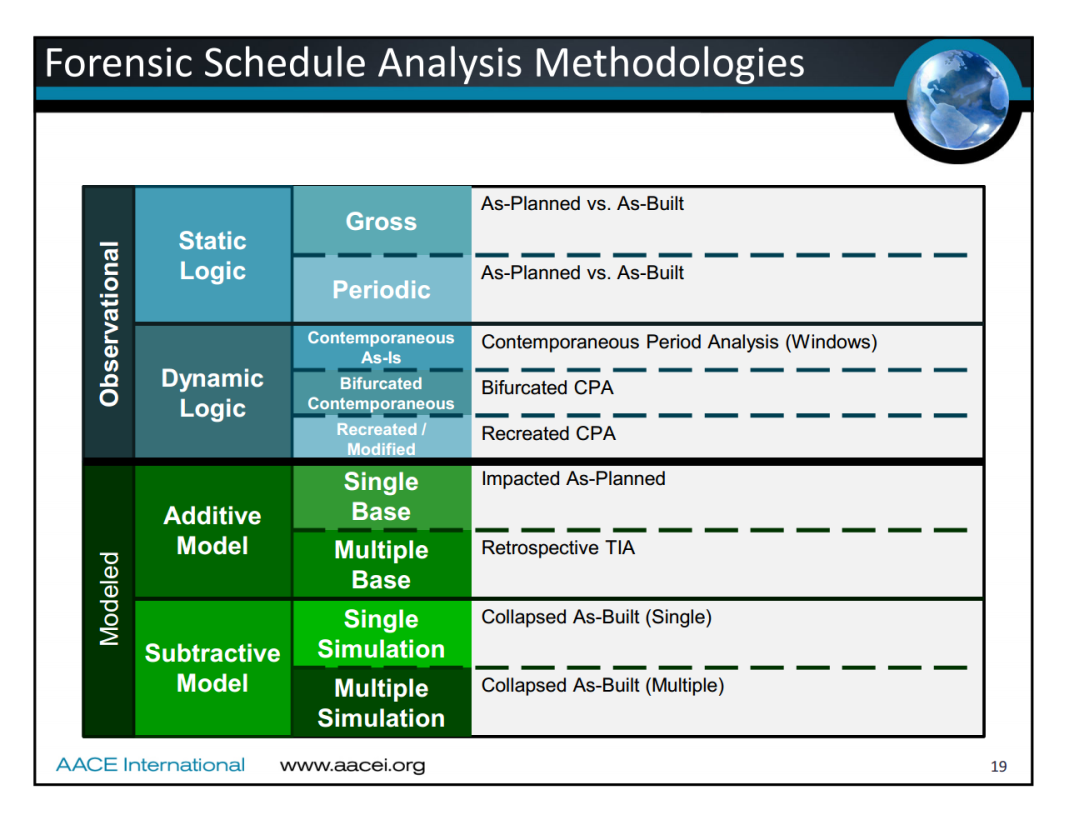
Figure 5 - Forensic Analysis Methodologies Summarized
Source: Livengood, John (2014) “Construction Claims A to Z" CDR 1484 AACE Symposium Bangkok, Thailand
Now that we have a greater understanding of the processes, resources and concepts necessary to analyse a schedule,, now we can start to explore the specific tools and techniques at our disposal, understanding that the professional forensic analyst is going to have to apply their professional judgement as to which tool/technique would be “best” or “most appropriate” in any given situation.
12.4.2 INPUTS
- Baseline CPM Schedule
- Updated CPM Schedule
- Specific Claims Or Disputes
- Counter Claims
12.4.3 TOOLS & TECHNIQUES
As emphasised previously the choice of delay/impact analysis methodology is dependent on very many factors and it is not the purpose of this guide to provide any form of recommendation. The employment of an appropriate technique will be dependent on the circumstances.
The following narrative reviews each of the main recognised delay/impact analysis methodologies, provides details of their implementation, potential operational problems and their various strengths and weaknesses.
The Association for the Advancement of Cost Engineering (AACE) International Recommended Practice No. 29R-03, “Forensic Schedule Analysis” (FSA RP) provides a taxonomy of forensic analysis methodologies in an effort to identify and describe unique methods that often are called by different names. This taxonomy identifies a first broad division in forensic methods between “observational” and “modeled”, which provides some clarity. The methods are identified by what the FSA RP calls the Method Implementation Protocols (MIP) necessary for a reasonable analysis process.
The observational methods in the FSA RP include one typically known as the As-Planned vs. As-Built (APAB) and several versions of another group of analyses called Contemporary Period Analysis (CPA), based on whether the CPA is bifurcated (split) to isolate the effects of progress only, and whether the analysis schedules are used substantially as they exist or recreated.
The modeled methods include two general types based on modeling fragnets to represent delays, and those are called “additive” and “subtractive”.
With the additive methods, these represent methods that add fragnets to the network and use those to depict delay; these are typically known as the Impacted As-Planned (IAP) and the Time Impact Analysis (TIA). The TIA is not to be confused with the prospective method of modeling delays before the impacts from the delays have been absorbed into the schedule. This method of analysis is described in the Planning & Scheduling Standard of Practice as it is a contemporaneous method of analysis and not a forensic method.
With the subtractive methods, these represent methods that replace the as-built data with network logic, allowing delays to be removed from the as-built schedule and recording the collapse time. These subtractive methods represent two types, one based on a single collapse of the schedule and one that collapses the schedule period by period.
These FSA RP methods will be identified with each of the analysis methodologies for clarity and correlation with this Module 12 - Managing Forensic Analysis.
12.4.3.1 As-Planned v As-Built (APAB)
Some other common names for this methodology include:
- AP vs. AB,
- Planned vs. Actual,
- As-Planned vs. Update, and
- Plan vs. Actual.
To correlate to the FSA RP, the As-planned v As-Built (APAB) can be implemented in two methods, the
- MIP 3.1 – Observational/Static/Gross and the
- MIP 3.2 – Observational/Static/Periodic.
In order to undertake an as-planned v as-built analysis an as-planned programme is required as well as built records in sufficient detail to be able to establish the actual timing of the planned activities.
As stated above when the as-planned programme is updated with progress some of the available software will allow actual start and finish dates to be entered, thus an as-built programme will be produced as the works are undertaken and the progress monitored.
This is a very simple methodology and it is a basic comparison between the timing of the as-planned activities and the actual timing. As such it is easy to understand, relatively simple to produce and commonly used.
In any form of delay/impact analysis a review of what was planned and what actually occurred is very often an excellent starting point and provides an initial view of where the delay/impacts occurred. Conversely such a comparison will also indicate where the works were actually undertaken much in line with the planned timings enabling areas to be disregarded.
This methodology is only a graphical comparison and although it may clearly illustrate that the works were delay/impacted and undertaken differently when compared with the original programme it does not illustrate the cause. As such the methodology does not demonstrate ‘cause and effect’.
Although this is the case accompanied by an appropriate narrative describing the delay/impacting events a planned v as-built analysis may prove sufficient. As emphasised previously the choice of methodology will be dependent on the circumstances.
It is likely that the as-built timings will differ from the planned timings simply due to the uncertain nature of any planned programme. On certain projects the programme may have been substantially amended and re-issued making the selection of the planned programme to utilise as the baseline difficult.
Similarly it may prove problematic to reconcile the as-built activities if the actual sequencing of works varied greatly from that planned.
As well as the availability of the planned programme an as-planned v as-built comparison will obviously be determined by the availability and quality of the as-built records.
When reviewing the as-built records it is preferable to keep the level of detail the same as that of the planned programme making comparison simple and on a ‘like-for-like’ basis. It may also to prove beneficial to also, in selected areas produce the as-built activities in as much detail as possible. For instance the planned programme may indicate a single activity for the brickwork and block work, comparing a similar single as-built activity may have limited benefit.
Using the available records such as daily diary sheets, meeting minutes, progress reports and the like a detailed as-built programme of the actual progress of the brickwork and blockwork will be produced. This programme may include activities indicating such events as, plant breakdowns, scaffold adaptations, lack of labour, deliveries, inclement weather, variation works etc. The addition of such information as the timing of technical queries and instructions will also be useful in helping to build up a factual ‘picture’ of the progress of the works.
An as-planned v. as-built analysis need not be limited to a programme comparison and such other graphical comparisons such as histograms and ‘s’ curves may prove useful to help support accompanying narrative or more technical forms of analysis..
As an example on a large civil engineering contract a traditional cumulative ‘s’ curve comparing the volume of concrete planned to be placed with the actual volume placed may provide a valuable guide to where any delay/impact occurred.
Similarly the production of curves illustrating the planned and actual progress achieved and as-planned v as-built labour histograms may be beneficial.
Summary:
- Requires an as-planned programme and adequate as-built records;
- Relatively simple to produce and easy to understand;
- Always an excellent starting point in any form of delay/impact analysis;
- A graphical comparison only does not provide ‘cause and affect’.
12.4.3.2 Contemporaneous Period Analysis (CPA)
Other common names for these analyses include:
- Contemporaneous Project Analysis,
- Observational CPA,
- Update Analysis,
- Month-to-Month Window Analysis, and
- Windows Analysis.
To correlate with the FSA RP, the Contemporaneous Period Analysis (CPA) may be implemented in three methods: MIP 3.3 – Observational / Dynamic / Contemporaneous As-Is, MIP 3.4 – Observational / Dynamic / Contemporaneous Split, or the MIP 3.5 – Observational / Dynamic / Modified or Recreated.
Performing a CPA starts with the recognition that a well-maintained schedule or programme will show the effects of delay, whether or not actual delay activities are inserted into the schedule to model delay. In any project, if there is critical path delay, some activities that represent the contractual scope of work will have been delayed and that delay can be identified in the schedule. Without modeling or adding any activities, that well-maintained schedule will show where the delays happened and provide direction to start the research into contemporaneous project documents to determine what drove those activities into delay. This research effort is vital to a reasonably performed and accurate analysis because very often there are project issues that create delays.
An example of this is a first floor masonry wall activity that shows a delay, either a start delay or a production delay (increased actual duration over original duration delaying the finish date) from the baseline planned schedule dates. The level of detail in the schedule may only show the masonry wall activity without detailing the delivery details of masonry materials, the daily production of installation, the delivery of bearing plates for embeds, or interference by other trades. When performing the research, it could easily be that bearing plates were not delivered on time to allow the masonry to continue above the bearing plate elevation. And the research might show that there was an RFI which delayed the attachment of studs to the bearing plates for anchors in the masonry. The RFI might be an owner-caused delay, or it might have been answered timely but the structural steel fabricator had to order the proper studs for the bearing plates.
Without the serious research effort required to perform the analysis, the analyst might select the masonry wall as the source of critical path delay and attribute the delay to the mason when it might be any of a number of other sources of responsibility.
This research need is not isolated to CPA methods, but is required to perform any of the methodologies. The research is generally more time consuming and extensive than the identification of delay in the schedules. However, without it, the analysis will likely be faulty and not stand up to scrutiny.
The CPA involves using the contemporaneous update schedules. The reason that the FSA RP shows three types is due the type of analysis and the amount of revision necessary before starting the analysis. As an observational analysis, ideally no changes should be made, however, often there are logic issues or missing scope that will significantly change the analysis if omitted. These analyses are always implemented in short periods of time, commonly called Windows, and often align with the update periods and/or billing cycle from the project.
With the first two types, the CPA As-Is and the CPA Split or bifurcated, the existing schedules are used with as little rectification as possible. The third type, the CPA Modified or Recreated, tends to make fairly serious revisions to the schedules, often either because no schedules exist or they are so deficient that they cannot be used.
(1) CPA "AS-IS"
Sometimes, when there has been extensive and good technical schedule review, the CPA As-Is (FSA RP MIP 3.3) can be performed As-Is, either using the schedules exactly as they were prepared during the project, or with minor rectification to “correct” problems with the original schedules. These problems often relate to missing scope, missing logic, inappropriate logic, or misalignments with the contemporaneous plan. The analyst should use his or her experience to provide expert opinion as to the appropriate rectification, if any, that is needed for the schedules to provide the basis for analysis.
Clearly, the fewer changes that need to be made to the schedules, the less likely it is that challenges might be raised by the trier of fact. Every change is subject to challenge, and each should be identified in the analysis report with the rationale for the need to make the change to the contemporaneous schedules. It is important that the contemporaneous understanding of the critical path is recognized and taken into account in the analysis, as that critical path likely influenced the project management decisions that were made during the project.
One reasonable approach to minor rectification when the schedules were not approved is to modify those schedules only enough to satisfy the rejection comments. This entails using the contemporaneous schedule review comments, typically performed by the Owner, and making the corrections that were found to be deficient. This results in a schedule that would have been “approvable” during the project, and generally is a stronger rectification than other types.
So minor rectifications can be made without the analysis type changing to the CPA Modified or Rectified, but it is a judgment on the part of the analyst as to the threshold when rectifications become revisions that move the analysis methodology from CPA As-Is to CPA Modified or Recreated.
(2) CPA "SPLIT" or Bifurcated
This approach is very useful in determining what contemporaneous decisions were made for mitigation or resolution of impacts. The CPA Split or Bifurcated (FSA RP MIP 3.4) methodology takes the previous updated schedule each period and simply imports the actual progress from the following (current period under investigation) period. This progress then is allowed to drive the previous period schedule and shows the ramifications of progress alone on the contemporaneous plan.
This is a useful approach particularly because it helps expose the actions of the scheduler at the time of the update. Not atypically, often the scheduler is updating the schedule at the last minute, and small amounts of delay are simply “corrected” without input or participation of the project management team, simply to be able to submit the schedule on time, and often to avoid showing a prediction of late completion. These minor “corrections” of the schedule logic almost always serve to regain lost time on the project, but are very risky adjustments, particularly since the gains often are made by reducing original durations of activities along the critical path in the future. Sometimes progress resulted in gains in completion predictions and these gains can be identified and researched to determine the responsibility allocated to the gains. When the gains are used to mitigate previous delays, it allows for appropriate responsibility assignments for acceleration or mitigation.
The methodology is excellent for exposing this type of adjustment in the schedule. Once the progress is imported, the schedule can be compared to see what the effects of progress only did to the prediction of completion milestones. This provides a view of the project contemporaneous performance.
Then, the progress-only schedules can be compared to the full period update schedule, and the differences between the two will show the effects of logic changes.
(3) CPA "MODIFIED" or Recreated
When the update schedules simply are not of high enough quality or don’t exist, it may be necessary to make extensive revisions or create schedules to model the contemporaneous conditions of the project. The CPA Modified or Recreated (FSA RP MIP 3.5) methodology covers both these areas and includes more extensive revisions that tend to change the original schedules significantly.
Of the CPA methods, this should be the method of last choice. This methodology covers de-progressing or de-statusing schedules to “fill in” large gaps in update schedule series when needed to analyze smaller periods than the existing updates. Often, there are a number of delays that existed within the larger periods and the accuracy of analysis is better when it examines smaller windows of time to segregate delays across the longer period of missing schedules.
The risk with the use of this methodology is that it may be perceived as a hypothetical analysis since it is based on created schedules rather than the contemporaneous updates, but it is generally only used when there are no available schedules. This risk can be minimized if care is taken with the development of the recreated update schedules. The operation should be transparent, defined in the expert report, and designed to be repeatable by someone else using the same data.
Modifying the schedules involves significant revisions to the contemporaneous or current plan, requiring some subjective decisions regarding the project management intent. This is generally done when the schedules did not model the contemporaneous plan and thus could not be used for analysis. Modifications should be limited as much as possible and all modifications explained in the analysis.
De-progressing or de-statusing involves taking an updated schedule and removing progress back to the beginning of a window identified on some rationale, such as to align with invoices or to encapsulate or segregate impact events. The process of removing progress includes removal of actual start or finish dates that occur after the beginning of the window selected. The beginning of that window would establish the data or status date for the schedule update to be recreated. If the activity started but did not complete within the chosen window, the actual finish date would be removed and the Remaining Duration (RD) set appropriately for when the activity was planned to complete. If the activity did not start, then both actual finish and actual start would be removed and the RD set to the Original Duration (OD) of the activity before the period beginning.
Once those schedules are created or modified, the CPA is performed in the same manner as the other two types of CPA methodologies.
12.4.3.3 As-Planned Impacted (API) or Impacted As-Planned (IAP)
Other common names for this methodology include:
- Impacted Baseline,
- Plan Plus Delay,
- Impacted Updated Analysis,
- Time Impact Evaluation,
- Fragnet Insertion, and Fragnet Analysis.
To correlate with the As-Planned Impacted or Impacted As-Planned (IAP) (FSA RP MIP 3.6) RP, the IAP is covered under the MIP 3.6 – Modeled / Additive / Single Base.
The as-planned impacted methodology involves adding or impacting the delay/impacting events onto the planned programme and it is probably the most commonly used retrospective critical path based techniques.
The technique involves adding additional activities to the planned programme to simulate the timing of the alleged delay/impacting events. By re-scheduling the programme the delay/impact to overall completion, if any can be quantified.
In undertaking such an exercise a contractor would impact the delay/impacts for which the Employer is considered responsible, onto the programme.
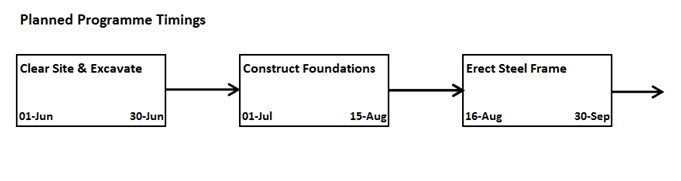
Figure 6 - Typical Planned Activities
Source: [ pending relevant citation ]
Figure 6 above illustrates a contractor’s simple planned sequence of initial site clearance and excavation, foundation construction and steel frame erection. In all cases the ‘finish-to-start’ programme logic applied means that each activity must be complete prior to the subsequent activity commencing.
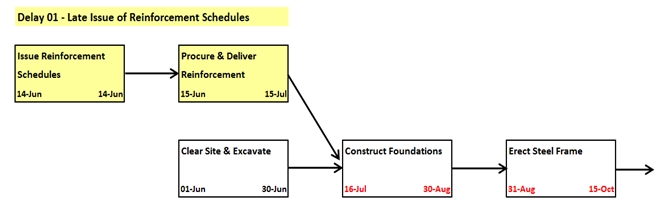
Figure 7 - Impact of Delay/impact
Source: [ pending relevant citation ]
Figure 7 above illustrates the same planned sequence with ‘Delay/impact 01 – Late Issue of Reinforcement Schedules’ impacted.
In undertaking this exercise two new activities have been added. The first indicates the issue of reinforcement schedules to the contractor on 14 June, with the second additional activity showing the procurement and delivery of the reinforcement being undertaken between 15 June and 15 July.
A new link has been added to indicate that the construction of the foundations could not commence until after the delivery of the reinforcement.
Following re-scheduling of the programme the impact of this ‘Delay/impact 01’ is to prevent the commencement of the foundations until 16 July and to delay/impact the completion of the steel frame by 15 days from 30 September to 15 October. If this activity of the steel frame erection is on the critical path then the overall completion of the project would also equally be delay/impacted by 15 days.
It is good practice to add and analyse the impact of the delay/impacting events individually and on a sequential and chronological basis.
To undertake this technique a suitable planned programme in a critical path format is required. If many planned programmes have been produced and amended the choice of programme may be difficult. Although the programme prepared and issued at the outset of the project represents the contractors planned intent at that time, later issues and amendments may indicate that this intent changed, in some cases these changes may be substantial.
If these changes are due to the fact that the planned intent indicated by earlier programmes was impractical then the choice of programme will obviously be difficult.
The selected planned programme will also need to define the activities at a sufficient level of detail. For example it will prove difficult to impact a delay/impacting event relating to say changes to a ceiling in a specific room on the third floor if the planned programme simply has an all-encompassing activity for ceiling installation.
Further difficulties will exist if activities covering certain areas of the works have been omitted and it may also be prove difficult retrospectively to determine precisely what works certain activities represent.
To enable the technique to be undertaken the selected programme will need to be in a fully logic linked critical path format. One further common problem occurs when the planned programme is not fully logic linked or includes no logic at all. In these cases the retrospective addition of logic is often the subject of argument as to whether it is reasonable and whether it reflects the original planned intent.
The as-planned impacted technique can be used where the as-built records are insufficient. Although one of the commonly used of the retrospective critical path based methodologies it probably attracts the most criticism due to the fact that the results are theoretical and do not reflect what occurred and specifically do not reflect the contractors own delay/impacts.
A simple comparison between the results generated and what actually occurred may be sufficient to demonstrate that the analysis is flawed and therefore of little value.
Take the previous example which related to alleged delay/impact caused by the late issue of bending schedules. The impacted activities indicate that the reinforcement was not delivered until 15 July which prevented the foundations from commencing until 16 July. This in the planned context subsequently caused a 15 day delay/impact to the completion of the steel frame erection.
This is however theoretical and does not necessarily reflect what actually occurred. The contractor may have had his own problems during the site clearance and excavation works delay/impacting completion of this activity until say 21 July. The earliest time that the foundations could commence would therefore be on 22 July. Delivery of the reinforcement on 15 July would therefore be one week prior to the earliest time that the foundation works could commence and in advance of the actual course of the works, thus no delay/impact would have occurred.
Although criticised for being theoretical and not considering what actually occurred the above example illustrates that for the contractor this may have some advantage!
When undertaking such an as-planned v as-built analysis consideration of the likely theoretical nature of the results must be considered. Although the subject of criticism the methodology can be relatively simple to produce and understand and where the issues are simple and where the programme logic is relatively prescriptive its use may be considered appropriate.
Summary:
- Requires a fully logic linked as-planned programme;
- Relatively simple to produce and understand;
- Can be used where insufficient as-built records exist;
- Results tend to be theoretical and may not accord with what actually occurred.
12.4.3.4 Time Impact Analysis (TIA)
Some other common names for this methodology include:
- Window Analysis, Windows Analysis,
- Impacted Updated Analysis,
- Time Impact Evaluation,
- Fragnet Insertion, and Fragnet Analysis.
To correlate with the FSA RP, the Time Impact Analysis (TIA) is covered under the MIP 3.7 – Modeled / Additive / Multiple Base.
Time impact analysis involves the impacting or adding of the delay/impact onto the planned programme in much the same way as the as-planned impacted technique.
However, rather than the delay/impacting events being inserted into the original planned programme they are inserted into the planned programme which has been updated with progress at a point immediately prior to the event occurring.
This updated programme represents a ‘snapshot’ of the status of the works at the time the delay/impact occurred and therefore tends to overcome some of the theoretical problems associated with the as-planned impacted (IAP) methodology. Notwithstanding this, impacting of the event will indicate likely delay/impact and may not necessarily indicate what in the event actually occurred. Time impact analysis is therefore essentially a prospective technique used to ascertain the likely impact of delay/impacting events as they occur.
The NEC form of contract specifies the use of this methodology to quantify extensions of time on a prospective basis as the works progress, and generally this methodology is the preferred method of prospective analysis in the international arena. Under U.S. case law, use of a critical path schedule and prospective modeling of delays are supported and preferred.
This technique can be used retrospectively to assess the impact of a delay/impact at the time that it occurred, however as pointed out above the results well represent the likely impact and will not necessarily reflect the event as it occurred.
To be able to use this technique retrospectively will require the availability of regular progress updates and a fully networked planned programme. If this has not been undertaken contemporaneously it may be possible to create them retrospectively, however as commented previously such an exercise will inevitably include an element of subjectivity and will be open to criticism.
When used retrospectively the technique can be used more forensically the results can be tracked and compared with the as-built data and the impact compared with the actual delay/impact recorded by the following progress updates. As an example a delay/impact can be impacted onto the programme updated with progress as at say the end of October indicating a likely delay/impact of 3 weeks. Using the as-built records and further progress updates the delay/impact can be tracked and the actual impact assessed (this is not too dissimilar to a windows type of review – see below).
Summary:
- Requires logic linked programme updated with progress when used prospectively;
- Additionally requires as-built records if used retrospectively in a forensic manner;
- If programme has not been updated with progress contemporaneously it may prove difficult to re-create retrospectively and may contain elements of subjectivity;
- When used prospectively the results will indicate likely delay/impact and may not reflect what actually occurred;
- When used retrospectively and forensically a detailed assessment of the delay/impact can be obtained, this may however prove a lengthy and costly exercise.
12.4.3.5 Collapsed As-Built (CAB) or But-For Analysis
Some other common names used to represent this methodology include:
- As-Built less Delay,
- Modified As-Built,
- Windows As-Built But-For,
- Look-Back Window, and As-Built Minus.
To correlate with the FSA RP, the Collapsed As-Built (CAB) is implemented in two methods, the MIP 3.8 – Modeled / Subtractive / Single and the MIP 3.9 – Modeled / Subtractive / Multiple Base.
In certain respects the collapsed as-built technique (CAB) is the opposite of the as-planned impacted (IAP) with delay/impacts being removed from the as-built programme rather than added to the planned programme.
(1) Collapsed As-Built: SINGLE
The Collapsed As-Built (CAB) Single (FSA RP MIP 3.8) is methodology, after developing the collapsible schedule, removes all impacts from the single as-built zero-progress schedule to collapse the schedule back to the As-Planned Programme or Schedule. Since the as-built schedule contains all revisions and adjustments to the schedule during the project, it can be considered to be statistically accurate once validated than the as-planned schedule with the original logic.
The impacts are removed either globally all at one time, or in reverse chronological order, as a stepped extraction of delay events.
By utilising the as-built programme all delay/impacts and what actually occurred are considered. The removal by the contractor of the employer delay/impacts will allow the programme to ‘collapse’ and it is said that the result is what would have occurred had it not been for the delay/impacts.
When used by a contractor, delay/impacts for which the Employer is considered responsible would be removed.
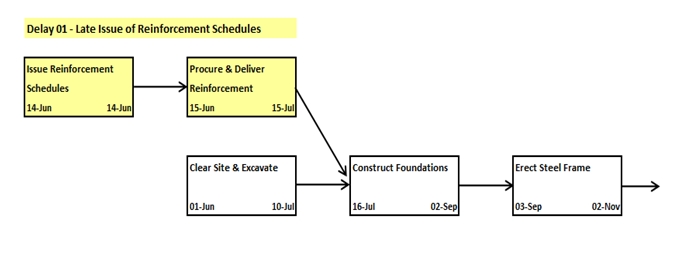
Figure 8 - As-Built Programme
Source: [ pending relevant citation ]
Figure 8 above indicates the as-built programme for the activities used in the previous example when commenting on the as-planned impacted technique.
In this case the activity timings reflect actual start and finish dates irrespective of what was originally planned and therefore consider all delay/impact that occurred.
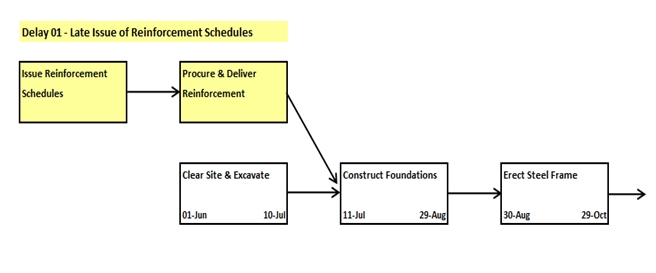
Figure 9 - As-Built Programme with Delay/Impact
Source: [ pending relevant citation ]
Figure 9 above represents the as-built programme with the delay/impact relating to the issue of the reinforcement schedules being removed. In practice rather than deleting the activities representing the delay/impact, it is common practice to reduce their duration to zero.
By removing the delay/impact associated with the reinforcement schedules the foundations can commence on 11 July following the actual completion of works to clear the site and excavate. Commencement at this time allows for any delay/impact caused by the contractor during the site clearance and excavation works.
Subsequently the erection of the steel frame could have been completed 5 days earlier than it actually was. If the steel frame was on the critical path overall completion will equally be 5 days earlier, the programme has therefore effectively ‘collapsed’ by 5 days.
Based on this example the late issue of the reinforcement schedules caused a 5 day delay/impact to the actual course of the works.
It is good practice to start with the removal of the later delay/impacts and subsequently remove delay/impacts in reverse chronological order.
The collapsed as-built methodology can be quite compelling as it reflects what actually occurred and all delay/impact, however it is dependent on the availability of adequate as-built records in order to produce a detailed as-built programme.
As commented previously even where good records have been kept it is often difficult to accurately ascertain activity timings particularly in respect of when activities were complete. In the case of foundations it may prove easy to determine start and completion dates based on available concrete pour records, however other activities such as 2nd services, joinery and decorations may be more difficult to determine.
To enable the programme to act dynamically when the delay/impacts are removed once the activity timings have been established logic will need to be applied. Again as commented previously critical path analysis is highly deterministic and is reliant on precise data any errors in the as-built timings even if relatively minor will affect the results.
It is also likely that the application of accurate logic links based on the available records will not prove easy with various assumptions needing to be made. For example an activity may have taken 16 weeks to undertake, however if it was recorded as being 95% after 10 weeks when applying logic it may be considered reasonable to assume that the activity was substantially complete in 10 weeks however such assumptions may be subjective.
It may also prove difficult to simulate activities that have been undertaken intermittently and difficulties may also arise where differing calendars are used to simulate differing shift patterns such as overtime and weekend working.
The removal of delay/impacts from the longest path will cause the programme to collapse, however this may not represent the critical path at the actual time the delay/impact occurred. The programme will not collapse when for instance a removed employer delay/impact is concurrent with a delay/impact caused by the contractor.
Summary:
- Requires detailed as-built records;
- Can be time consuming and costly to produce;
- Considers what actually occurred and all delay/impact;
- Application of the logic to the as-built activities can be subjective;
- Will not collapse when delay/impacts are concurrent, only collapses when delay/impacts removed from the longest path.
(2) Collapsed As-Built: MULTIPLE Base
The Collapsed As-Built (CAB) Multiple Base (FSA RP MIP 3.9) methodology is similar to the CAB Single analysis type, but is performed on more than just the as-built zero-progress model. The progress updates are used in this approach, and each collapsed update is correlated to the previous update schedule.
The basic procedure differs from the CAB Single analysis by the consideration of the logic changes and other network revisions that occur during each update.
This approach is considered to be more accurate than the single CAB since it takes into account the changing nature of the Critical Path within each update that is collapsed, although it is considerably more work to develop and analyze.
Many decisions must be made during this approach, and it is important to develop a protocol that ensures objective and consistent steps performed during the analysis. The large number of decisions tend to complicate the analysis and raise the risk of the rate of error simply based on the volume and types of decisions.
12.4.3.6 Disruption, Productivity, and Other Analyses
(1) Disruption & Loss of Productivity
Delay/impact and disruption are often talked about collectively and seemingly as a linked issue however they are discretely different issues.
The concept of delay/impact is easy to understand, not too difficult to measure and relates to lateness when measured against a set benchmark, usually the construction programme or contractual requirement.
Disruption however relates to a loss of productivity and efficiency. As an example say that a contractor made a reasonable allowance of 500 man hours were to undertake the joinery installations. The late delivery of internal doors would delay/impact their installation causing overall delay/impact and prolongation of the joinery works. In this case disruption may not necessarily occur with the planned 500 man hours simply being expended over a longer period.
Disruption would occur if the site working conditions were different to those envisaged. As an example, slow progress of preceding trades may necessitate that in order to meet the programme requirements, the joiner working concurrently and inefficiently alongside other trades such as partitioning and flooring, something that was not originally anticipated.
Together with this variations to the ironmongery may lead to it being necessary to make return visits to finally complete the doors. These issues may not necessarily cause any overall prolongation or delay/impact with joinery works being undertaken and completed in the originally anticipated overall period.
However rather than expending 500 man hours, because of disruption and inefficient working the joiner expended 600 man hours. In this case no delay/impact occurred however the joinery works were disrupted necessitating the expenditure of an additional 100 man hours and as such the cost of the joinery installations was greater than the planned budget.
Disruption may lead to delay/impact and conversely delay/impact may lead to disruption however this is not necessarily always the case.
There are a great many events that can lead to disruption and a loss of efficiency with some of the common events and consequences including:
- Overtime - Physical fatigue due to extended working hours;
- Trade Stacking - Rather than trades working sequentially as originally planned, in order to meet the programme requirements several trades work alongside each other, possible in limited working areas;
- Limited Access to Work Areas - Issues such as a lack of information and delay/impact by preceding trades may restrict the working areas available;
- Piecemeal / Late Release of Information - Will result in limited work being available and possible return visits to complete work;
- Learning Curve - Initial outputs tend to be lower due to the need for the work force to familiarise themselves with the required works (the learning curve). Changes of working procedures and changes in labour will necessitate increased learning curves.
- Morale - A lack of morale will impact on work outputs and can be caused by many reasons such as all of those given above.
The quantification and analysis of disruption is notoriously difficult and disruption is often caused by multiple rather than a single event. Very often both parties may have to some extent contributed to the inefficiencies experienced.
The main techniques associated with the analysis of disruption are as follows:
(2) The Measured Mile Analysis
This technique compares actual output achieved in a period when the works were undertaken much as envisaged and where no inefficient working and disruption attributed to the Owner/Employer or third party occurred with the output achieved when the works were disrupted. The ‘Delay/impact and Disruption Protocol’ published in the UK by the Society of Construction Law favours this technique saying:
“The most appropriate way to establish disruption is to apply a technique known as ‘The Measured Mile’. This compares the productivity achieved on an un-impacted part of the contract with that achieved on the impacted part.”[1]
This is in keeping with formal dispute resolution forums around the world, the Measured Mile is a highly regarded analysis methodology when appropriately implemented.
One of the advantages of the measured mile approach is that it is based on the actual outputs achieved rather than outputs allowed for at the time of tender. These tender outputs are often used by contractors to substantiate their claims, however they are open to criticism on the basis that they were unrealistic and not achievable. They often also do not take into account the full scope of work or conditions under which the work will need to be pursued, and are an estimate.
When making the comparison it is obviously important to ensure that it is being undertaken on a like-for-like basis. With any operation it is unlikely that the same rate of output will be achieved throughout the duration of the operation due to such factors as the need for an initial learning curve and the quantity of work available. Similarly where overtime and extended working has been employed outputs achieved are likely to be less than during normal working periods.
Identifying these like-for-like periods may in some cases prove problematic.
How persuasive and reliable the results of the technique are will be dependent on the detail and availability of the labour records. A low level of detailed records will mean that the results become more global in nature.
Similarly where the records are not detailed it may prove difficult to isolate the disruptive impact of individual events.
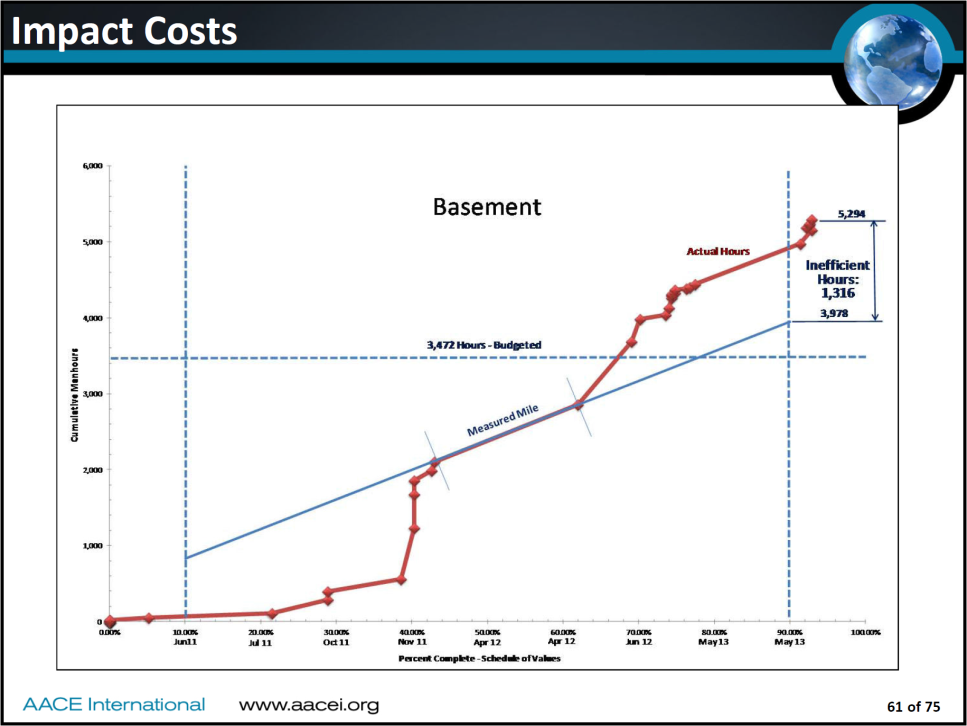
Figure 10 - Measured Mile Illustrated
Source: Livengood, John (2014) “Construction Claims A to Z" CDR 1484 AACE Symposium Bangkok, Thailand
(3) Earned Value Analysis
As described in Module 9- Managing Project Progress is a technique which compares four cumulative curves, these being the Budgeted Cost of Work Scheduled Early Date Curve (BCWSEarly), Budgeted Cost of Work Scheduled Late Date Curve (BCWSLate)the Budgeted Cost of the Work Performed (BCWP) or Earned Value and the Actual Cost of the Work Performed (ACWP).
This technique enables an ongoing review of cost and progress and will identify shortfalls in productivity. Differences in the planned and actual productivity can be quantified and by using contemporaneous records disruptive causative events can be identified.
To quantity disruption this technique requires detailed progress and cost data and is dependent on the efficacy of the baseline programme and budget.
(4) Use of Industry Studies
Various organisations, such as the Mechanical Contractors Association of America (MCAA) and the CIOB have undertaken research and published standard studies related to the impact on productivity due to various factors such as the effect of trade stacking and overtime work.
As an example overtime work is likely to cause a general loss in productivity due to physical fatigue resulting in poor workmanship and a general loss in productivity. Standard publications attempt to quantify such loss of productivity based on the extent of such overtime work, suggesting for instance a 10% loss of production based on limited overtime work rising to 25 – 30% where the working hours are substantially extended.
The use of such industry studies are useful where records are lacking or where the works were disrupted from the outset and where the measured mile cannot be utilised.
These published outputs can also be used as a guide to assess whether any claimed quantification of disruption is reasonable, but generally should not be used as the only or primary source of analysis.
(5) Total Cost or Time and Modified Total Cost or Time Claim or Global Claim
The total cost claim is a very global approach to disruption and simply compares the labour cost / production budgeted with the actual labour cost / production achieved. The difference between these values, after making allowance for such things as variations, represents the alleged element of disruption.
Such a methodology is obviously open to criticism as it could be claimed that the original planned budget was inefficient and that the actual achieved outputs included an element of the contractors own inefficiency not associated with the events relied on as the cause of disruption.
When the original estimate is modified to account for missing scope, cost inaccuracies, and other mistakes in the estimate, claim is referred to as a Modified Total Cost or Time claim. It is more highly regarded than the Total Cost or Time Claim but still suffers from the same problems; it assumes that all delays and disruptions on the project are the responsibility of the Owner or Employer. Since this is not often the case, the methodology is not highly regarded in formal dispute resolution forums.
(6) Evidence to Demonstrate Disruption
To assist in the demonstration and to support any claim for disruption various forms of evidence will be required such as timesheets, labour allocation sheets, programmes, correspondence, minutes, progress reports and photographs as well as estimated tender rates.
As well as these contemporaneous records the compilation of further programmes, charts and histograms, to accompany the claim may also prove useful in helping to demonstrate the extent of any disruption being quantified.
Such aids include labour histograms to indicate the resource on site at particular times.
If disruption is alleged as due to poor, late and incomplete information programme charts and histograms indicating the timing of drawing issues, Owner’s Representatives instructions and technical queries will be invaluable.
Some comparison of these with the planned and/or as-built timing of the actual programme activities will also be beneficial.
Although the above charts and histograms are graphical and do not necessarily link the causes to the extent of the disruption claimed they will greatly assist in understanding the alleged causes of the disruption and will help demonstrate that disruption was likely and that the extent quantified is reasonable.
12.4.4 OUTPUTS
- Validated Or Substantiated Claims
- Invalidated Or Unsubstantiated Claims
12.4.5 REFERENCES & TEMPLATES
- NCHRP Report 747 (2013) "Guide For Conducting Forensic Investigations Of Highway Pavements"
- AACE’s Certified Forensic Claims Consultants Study Guide (2014) Http://Www.Aacei.Org/Cert/Cfcc/Cfcc_Certstudyguide.Pdf
- • Livengood, John, Kelly, Patrick (2015) “The Future Of Forensic Schedule Analysis: The Good, The Hard And The Scary- Part 1” Http://Www.Arcadis-Us.Com/Future_Of_Forensic_Schedule_Analysis_Good_Hard_Scary.Aspx
- Case Study- Mulholland, S. S (2009) Turner Construction And The University Of Florida. “Preliminary Forensic Analysis Report” Http://Www.Ortho.Ufl.Edu/Sites/Ortho.Ufl.Edu/Files/Pdf/Osmidocs/Usbc_Forensic_Investigation_Findings.Pdf
- Livengood, John (2014) “Construction Claims A To Z’ Cdr 1484 AACE Symposium Bangkok, Thailand
12.5 - Module 12-5 - Damage Analysis Phase
12.6 - Module 12-6 - Settlement Negotiations Phase
12.7 - Module 12-7 - Formal Disputes Resolution
GPCCAR M12-4, Revision 1.01