02.0 - MANAGING PEOPLE
02.1 - MODULE 02-1 - INTRODUCTION TO MANAGING PEOPLE
02.1.1 - WHAT IS THE PURPOSE OF MANAGING PEOPLE?
The purpose of the Managing People is to introduce the tools, techniques and methodologies, deemed appropriate to identifying, developing, preparing and compensating or rewarding people to work on or in support of projects, that have been “best tested and proven” and found to work on “most projects, most of the time”; provide a logical or rationale sequence showing when those tools or techniques would normally and customarily be used and in selected instances, show how to use those tools/techniques and/or where to find additional information on how to use or apply them.
In terms of the people management or “soft skills” processes, there is not any major or significant difference between how owners and contractors identify, select, develop, prepare, compensate, reward or otherwise manage people.
As projects become ever larger and more complex, managing those projects is proving to be less of a technical challenge and more of a people challenge. This is especially true as nearly all major projects are being done with disbursed teams consisting of men and women from all parts of the world, meaning we have to learn to deal with different cultures, languages, customs, laws and even the terminology is not consistent.
Managing people in a project environment can present some unique challenges not found in a functional or operational environment. As projects are a unique one-time event with a defined finish, identifying and acquiring the “right” or the “best” people poses some interesting challenges, as does motivating and rewarding them. This challenge is going to increase as more and more people are predicted to be living and working in a project based world as part of the contingent or part time work force.
Because projects are unique to humans, the starting process for project controls deals with the soft or human aspects. This is a valuable and challenging topic because most of us practitioners are used to considering how to develop a schedule or adjust a cost estimate or even analyse poor progress and find a solution, so to pause and understand the concepts and tools available to us which can help us to get the most from people on our team is a valuable tool.
To as great an extent as possible, the Guild has built or organized this module around the career path model typically followed by “project control” professionals.
Starting with the career path development plan, (in Module 02-2 - Develop Project Controls Career Path Development Plan) the Guild explores what the requirements are to play either a “generalist” (“project controls”) or a “specialist” role (i.e. planner/scheduler, cost estimator/QS, forensic analysis/claims analyst).
In Module 02-3 - Developing Individual Competencies, the Guild then explores how to select, develop, motivate and compensate the individual practitioner’s, followed in Module 02-4 - Developing Management Competencies with how to identify, develop and train managers.
Understanding that the best people in the world cannot realize their full potential is the system they are working in does not support the tactical and strategic objectives they are tasked with achieving, in Module 02-5 - Developing Organisational Competencies, we take a look at the organizational competencies necessary to support a project centric organization and more specifically, a project controls project support team.
Having looked inward to develop the project controls team, in Module 02-6 - Identifying And Engaging Stakeholders the Guild has us looking outward, helping us identify and manage stakeholders, not only to the project controls team but to the full project team.
02.1.2 - WHAT ARE THE PROCESS MAPS FOR MANAGING PEOPLE?
At the 1,000 meter level of detail this is what the process flow chart looks like to manage people. As this process applies equally to both the Owner and Contractor organizations, at this level of detail, the process maps are identical. Where they will change slightly is at the more detailed level process maps where we can see important differences in perspectives between Owner’s project control practitioners and those of Contractors, in terms of both the tactical and strategic objectives of the project.
This includes significant differences in the time horizons as Owner’s project control teams are looking at the Asset life span with the Project life span being just part of a much larger process, while Contractor’s are focused almost entirely on the project life span.
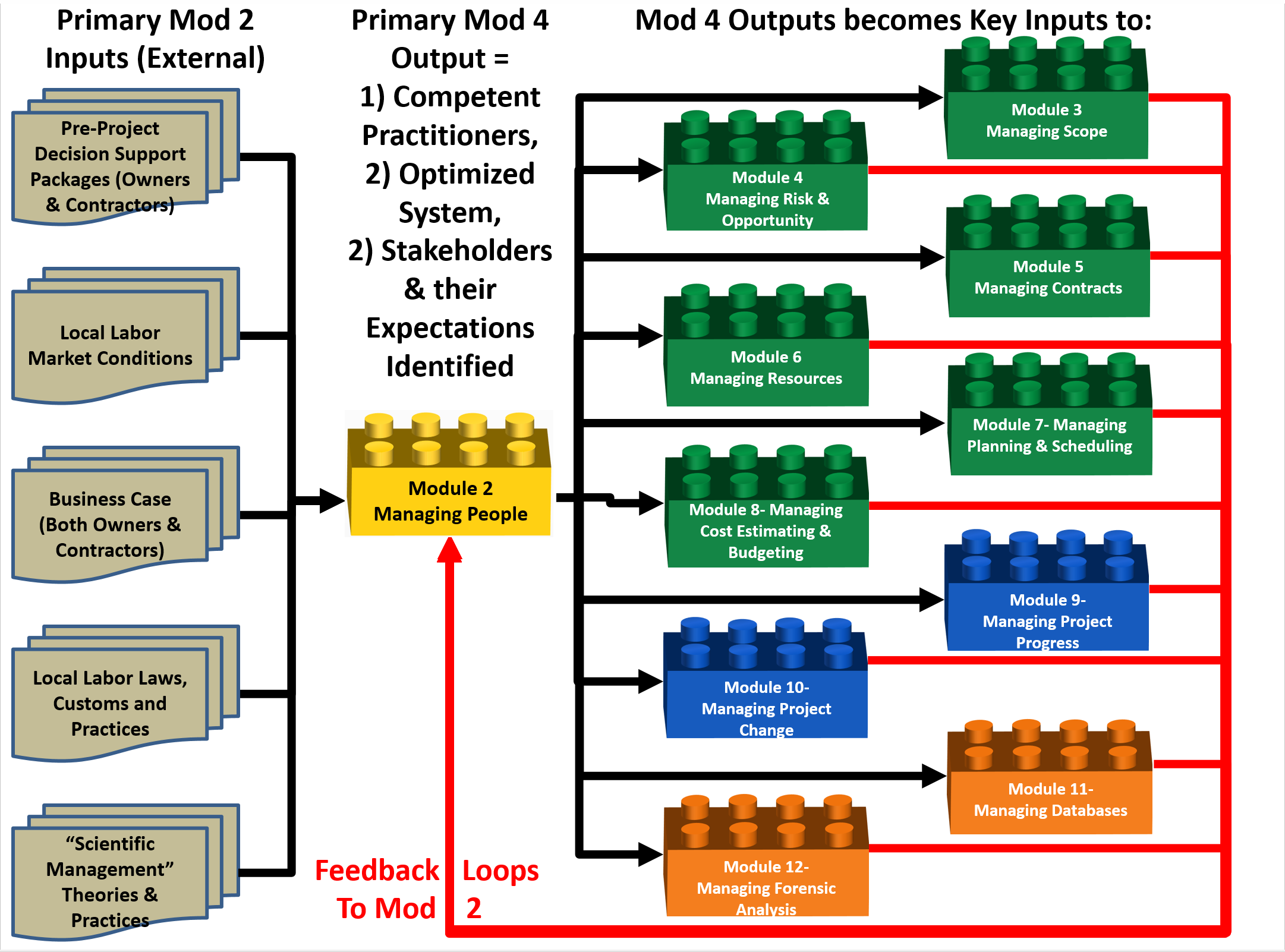
Figure 1 - 1,000 Meter Level Process Flow Chart for Module 2- Managing People, from BOTH the OWNER and CONTRACTOR ORGANIZATION PERSPECTIVE
Source: Guild of Project Controls
As we can see, the inputs to the managing people processes are initially all external and encompass a broad range of topics, many of which are local to the place or places where the project is going to be executed.
For the owner, the decision support packages (DSP’s) developed during the Asset Life Span phases 1, 2 and 3, before there even was an approved and funded project are key inputs, while for the contractor, the “Bid/No Bid” decision is the key input from the contractors perspective.
Another key input is the local labor market conditions for both owner and contractor. When there is high unemployment, owner organizations are pressured or encouraged to initiate projects while at the same time, when work is slow, contractors will often bid projects “at cost” just to keep their key people employed and to cover overhead costs. Likewise when there are shortages of workers, the cost of labor rises and in cases of shortages, workers need to be imported from other areas.
The business cases for both owners and contractors also figure into the people management processes. A perfect example can be found in the oil and gas sector right now. With oil prices low, and projected to stay low, oil and gas companies tend not to hire permanent employees, but rely more on contractors or temporary employment agencies to provide key people or skill sets.
Given that for owner organizations projects are COST or INVESTMENT centers- that owners return on investment or return on assets comes not from the project but from whatever product, service or outcome the project was undertaken to achieve, while for contractors, projects are PROFIT centers- that is, a contractor makes money or otherwise receives benefit directly initiating, planning, executing, controlling closing the project, these different perspectives have a major influence, especially in areas of compensation, recognition and reward systems.
Another major input into the people management processes are the local labor laws, customs and practices, which impact both owners and contractors. Especially for companies (owner and contractor) whose home office is located in another country, trying to do business in a region without knowing the local labor laws, customs and practices represents a major potential risk event. This is evident especially in the many conflict arears in the world.
The last input, “Scientific Management” coming from Frederick Taylor, Henry Gantt, Henry Fayol, Edward Deming and many others, up to and including the more current philosophers, such as Peter Drucker, Henry Mintzberg, Bruce Tuckman and Clarence “Kelly” Johnson play a major role in influencing how we manage today and what modifications or adaptations we have to make to their theories to managing “Gen X” and “Millennial” workers.

Figure 2 - The Managing People Process Map 100 Meter Level of Detail
Source: Guild of Project Controls
In the Process Map above we can see there are 5 processes which are linked together in some way. While these have been shown to be sequential, the modular nature of these processes indicates they can be moved around to suit the needs of any specific project, program or organization.
Refer specifically Module 2.2- Developing the Project Controls Career Path Development Plan - As one of the 5 requirements to earn the entry level credential is for an applicant to identify a mentor and develop a career path development plan, this has been built into the GPCCAR document as it is expected that those doing training whether in house volunteers, self-study or commercial training providers will include the development of a Career Path Development Plan as a part of the training process.
This model also explains the process against which those being tested and assessed will be scored, using the "Iowa State University Center of Excellence in Learning and Teaching". Rex Heer (2009) Matrix which compares the three different TYPES of KNOWLEDGE:
- Factual
- Conceptual
- Procedural
Against HOW that knowledge is APPLIED, using Revised Bloom’s 6 Cognitive Dimensions:
- Know or Remember
- Understand
- Apply
- Analyze
- Evaluate
- Create.
While this may seem of little or no interest to the practitioner, it will be of critical importance to your organization’s HR or Competency Development department.
Because projects can only be done by people, the Managing People Process is considered by the Guild to be an INITIATION process. That is, the outputs from these processes become either direct or indirect inputs into all subsequent processes.
This level of detail provides an over view of the Managing People processes, which give us a more granular, detailed look of the processes, what the normal and customary sequencing is likely to be, as well as the specific inputs, outputs, tools and techniques, and how they interact than the 1,000 Meter view, there is yet another deeper level of detail which the Guild calls the “ground” or “working level”. It is the next level deeper which contains the explanation for each of the modules shown above, telling more about what inputs are required, including providing some examples and/or templates; what tools, techniques are typically used, including providing examples or templates, and in selected instances, specific step by step instructions or links to additional resources, showing how to use each of these tools or techniques consistent with the Guild’s commitment to identify and advocate “best tested and proven” practices. In the following “ground” or “working level” you will also find examples or templates showing what the Guild believes are “best tested and proven” outputs should or could look like, with the expectation that practitioners will benchmark what they are now using, with the objective to improve upon what they are using now OR if they feel their current template is better, to share it with other members of the Guild by publishing a paper or proposing changes in the GPCCAR.
While this level of detail provides a more granular look of the processes and how they interact than the 1,000 Meter view, there is yet another deeper level of detail which the Guild calls the “ground” or “working level”. It is the next level deeper which contains the explanation for each of the modules shown above, telling more about what inputs are required, including providing some examples; what tools, techniques are typically used, including providing examples or templates, and in selected instances, specific step by step instructions or links to additional resources, showing how to use each of these tools or techniques consistent with the Guild’s commitment to identify and advocate “best tested and proven” practices..
02.1.3 - BACKGROUND INFORMATION FOR MANAGING PEOPLE
The table below (Figure 3) comes to us compliments of the National Association of Colleges and Employers (NACE) and further breaks down the “soft” or “people” skills into the top 19 traits or attributes which employers are seeking when they hire an employee. Applying Pareto’s “80/20” Rule we can see that the top two attributes employers are expecting to see in the people they hire are demonstrated LEADERSHIP skills and the ABILITY TO WORK IN A TEAM.

Figure 3 - NACE Attributes Desired by Employers (2016)
Source: National Association of Colleges and Employers (NACE)
Because the Guild based the GPCCAR “best tested and proven practices” on current market research this study by NACE formed the core or framework around which Module 2 was developed, with the objective being to try to as great an extent as possible, prepare the certified Guild members to be in demand, valued and respected by employers around the world.
02.2 - Module 02-2 - Develop Project Controls Career Path Development Plan
02.3 - Module 02-3 - Developing Individual Competencies
02.4 - Module 02-4 - Developing Management Competencies
02.5 - Module 02-5 - Developing Organisational Competencies
02.6 - Module 02-6 - Identifying And Engaging Stakeholders
GPCCAR M02-1 Managing People Process Map, Revision 1.01